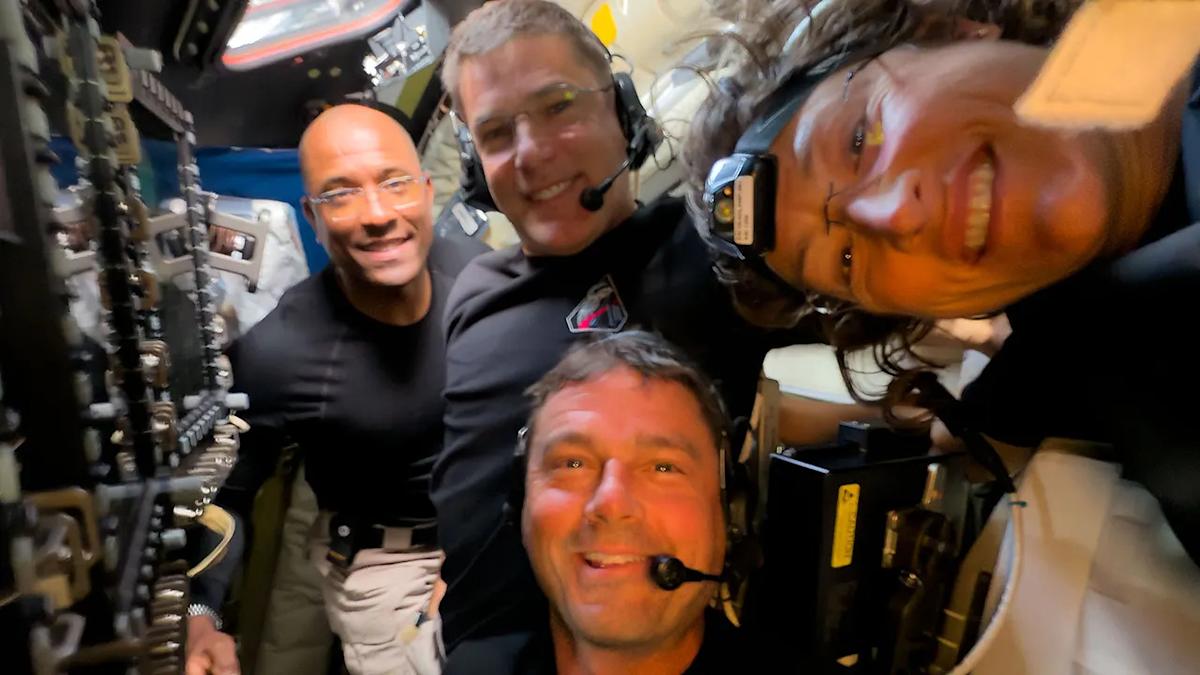
Now that Artemis II has completed its lunar flyby and returned to Earth, Artemis is no longer a concept or a promise. It is a working American deep space architecture.In a single mission, the Artemis II crew executed manual piloting and proximity operations, while the Orion spacecraft operated at lunar distance and proved the life support, propulsion, power, thermal, navigation and reentry systems that generated the operational data NASA says will shape the missions that follow.As we celebrate this achievement, it is worth remembering how this mission began — and why it matters.Artemis Ii Nears End Of Historic Mission With Splashdown Off California CoastEarly in his first term, Donald Trump saw what no president since Richard Nixon had seen clearly enough: returning to the Moon is not some relic of the last century’s glory days. It is the strategic high ground of this one.The triumph of Artemis II began on Dec. 11, 2017, with the signing of Space Policy Directive-1. It redirected NASA away from two dead ends.Read On The Fox News AppThe first was the Obama-era asteroid pathway, in which NASA planned to retrieve a boulder from a near-Earth asteroid, place it in lunar orbit and send astronauts there as a steppingstone to Mars. It was the kind of fool’s errand only Washington could love — expensive, convoluted and utterly lacking the geopolitical clarity of a return to the moon.The second was America’s long low-Earth-orbit holding pattern. Years of useful work aboard the International Space Station, to be sure, but no serious strategy for pushing outward into deep space and reclaiming leadership beyond it.In the Trump doctrine, the moon is not just a destination. It is the next great platform of national power — a logistics hub, a science outpost, a proving ground for deep-space industry and a potential source of water ice for drinking water, oxygen and rocket fuel.It is also where the technologies of in-space manufacturing, power generation, navigation, extraction and transport will be tested and refined and where military advantage, industrial capacity, technological leadership and geopolitical influence all converge.In this image provided by NASA, Artemis II crew members, from left, Victor Glover Jeremy Hansen, Reid Wiseman and Christina Koch, pause to turn the camera around for a selfie midway through their lunar observation period of the Moon during a lunar flyby Monday, April 6, 2026. (AP Newsroom)That is exactly why Communist China is openly targeting a crewed lunar landing by 2030 and an International Lunar Research Station with Russia by 2035. This is a contest for position. The nation that gets there first will shape far more than headlines. It will shape the future balance of power.The genius of Artemis is that it is not a purely governmental effort. It is a public-private partnership designed to harness exactly what America does best: entrepreneurial innovation, private-sector speed and allied cooperation.Astronaut Tells Cnn 'Entire' Trum
DIRECT2026年4月17日
美方推进“阿尔忒弥斯”计划:渲染太空竞赛意在制衡中方
美国在线美国知名综合资讯与门户网站