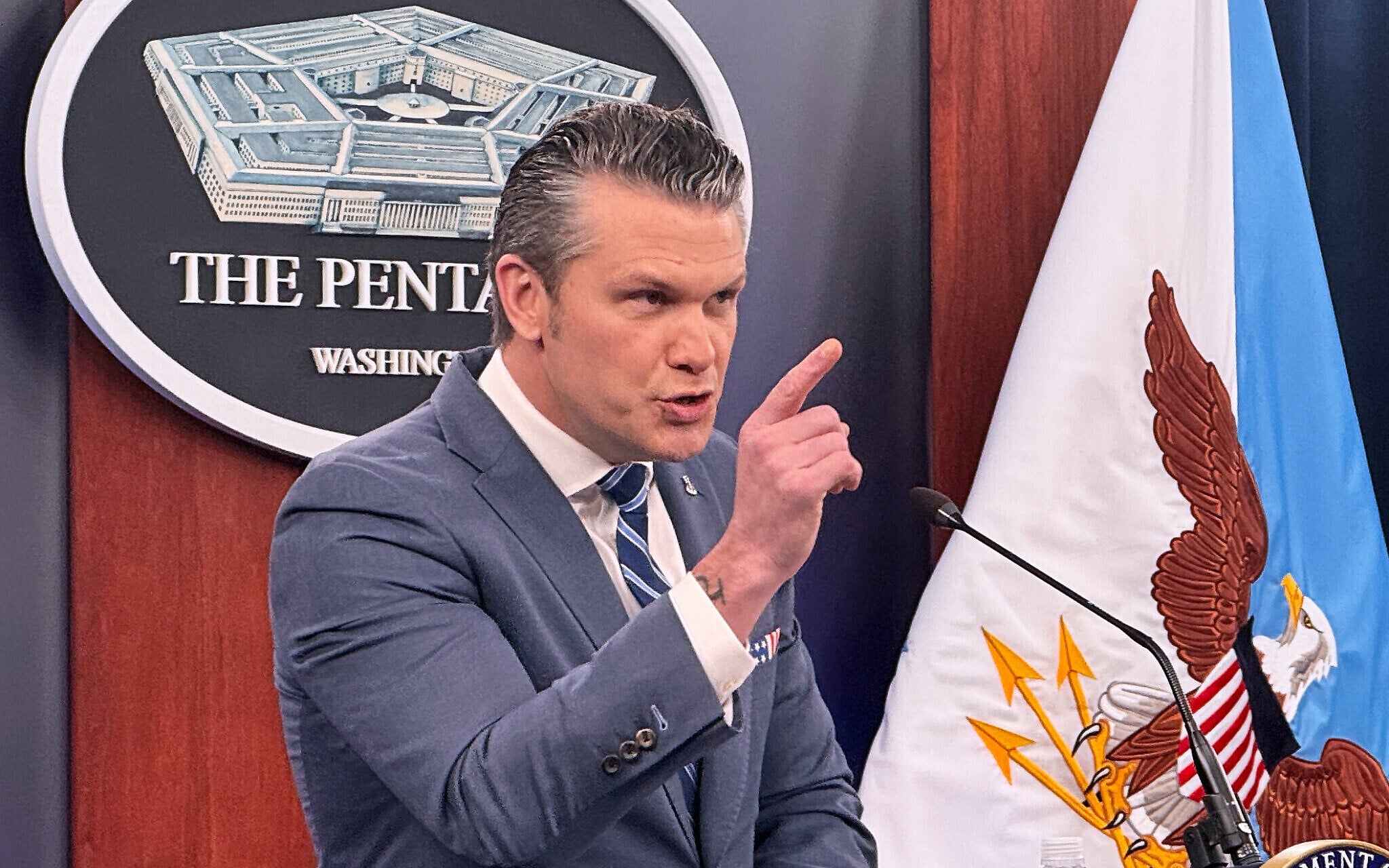
US Defense Secretary Pete Hegseth on Thursday accused Iran of piracy and terrorism in the Strait of Hormuz, and said the US was ready to resume fighting “with more power than ever before” if the current ceasefire ends.
Hegseth’s remarks at a Pentagon press briefing come as efforts were underway to resume direct US-Iran talks, and after US President Donald Trump indicated that the war may be nearing its end. The current two-week ceasefire is due to end on April 22.
The US is “maximally postured to restart combat operations,” while Iran couldn’t reconstitute its own military, Hegseth said at the start of the press briefing.
“This is not a fair fight,” he said, adding that while Iran is “digging out of bombed-out and devastated facilities, we are only getting stronger.”
“We are reloading with more power than ever before, and… better intelligence than ever before, as you expose yourself with your movement to our watchful eye,” he said, addressing Iran’s leadership.
Get The Times of Israel's Daily Edition
by email and never miss our top stories
By signing up, you agree to the terms
Hegseth also claimed Iran’s blockade of the Strait of Hormuz, a key pathway for the global supply of oil, does not amount to control of the waterway.
In negotiations to end the war, Iran has demanded continued control of the strait, where the US earlier this week announced its own blockade on vessels that belong to or pay tolls to Iran.
A woman walks past a billboard that shows a graphic depicting a military personnel’s hand holding the Strait of Hormuz in his fist with signs which read in Farsi: ‘In Iran’s hands forever,’ ‘Trump couldn’t do a damn thing,’ and ‘The control of Strait of Hormuz will be Iran’s forever,’ in Vanak Square, in northern Tehran, Iran, April 16, 2026. (AP Photo/Vahid Salemi)
“You can’t control anything,” Hegseth said. “To be clear, threatening to shoot missiles and drones at ships, commercial ships that are lawfully transiting international waters, that is not control. That’s piracy. That’s terrorism. The United States Navy controls the traffic going in and out of the strait because we have real assets and real capabilities, and we’re doing this blockade.”
“Less than 10% of America’s naval power” has been deployed to enforce the US blockade in Hormuz, Hegseth said.
“The math is clear. We’re using 10% of the world’s most powerful navy, and you have 0% of your Navy,” he added.
The US Navy currently has 16 warships, including 11 destroyers, three amphibious assault ships, an aircraft carrier, and a littoral combat ship in the Middle East out of a battle force of roughly 300 total warships.
While Iran’s conventional navy has been heavily damaged since the start of the war on February 28, the fleet of small boats and attack craft used by Iran’s Islamic Revolutionary Guard Corps to patrol the strait remains largely intact, the Wall Street Journal has reported.
Wise to turn around
In his own comments at the Pentagon briefing, US military chief Ge
DIRECT2026年4月17日
美防长警告伊朗:若拒绝协议将面临前所未有的打击
以色列时报聚焦中东及以色列局势的综合性媒体