Engineering and manufacturing company GKN Aerospace has partnered with the U.S. Air Force Research Laboratory (AFRL), committing $8.4 million to a new initiative called Titanium Industrialization and Technology Advancement for Near-net Additive Manufacturing (TITAN-AM).
The program is designed to utilize wire-based laser metal deposition (LMD-w) for real-world aerospace production, with a particular focus on building the large structural components that next-generation aircraft demand.
Five Pillars Driving the Program
TITAN-AM is structured around five interconnected priorities. The first is scaling LMD-w processes to handle oversized titanium structural parts. The second involves building comprehensive material performance databases to guarantee structural integrity.
Third, the team will develop advanced computational tools to sharpen both design and production outcomes. Fourth, non-destructive inspection techniques specifically suited to additively manufactured parts will be refined. Finally, the program will validate everything through hands-on demonstrations using real aerospace structural components.
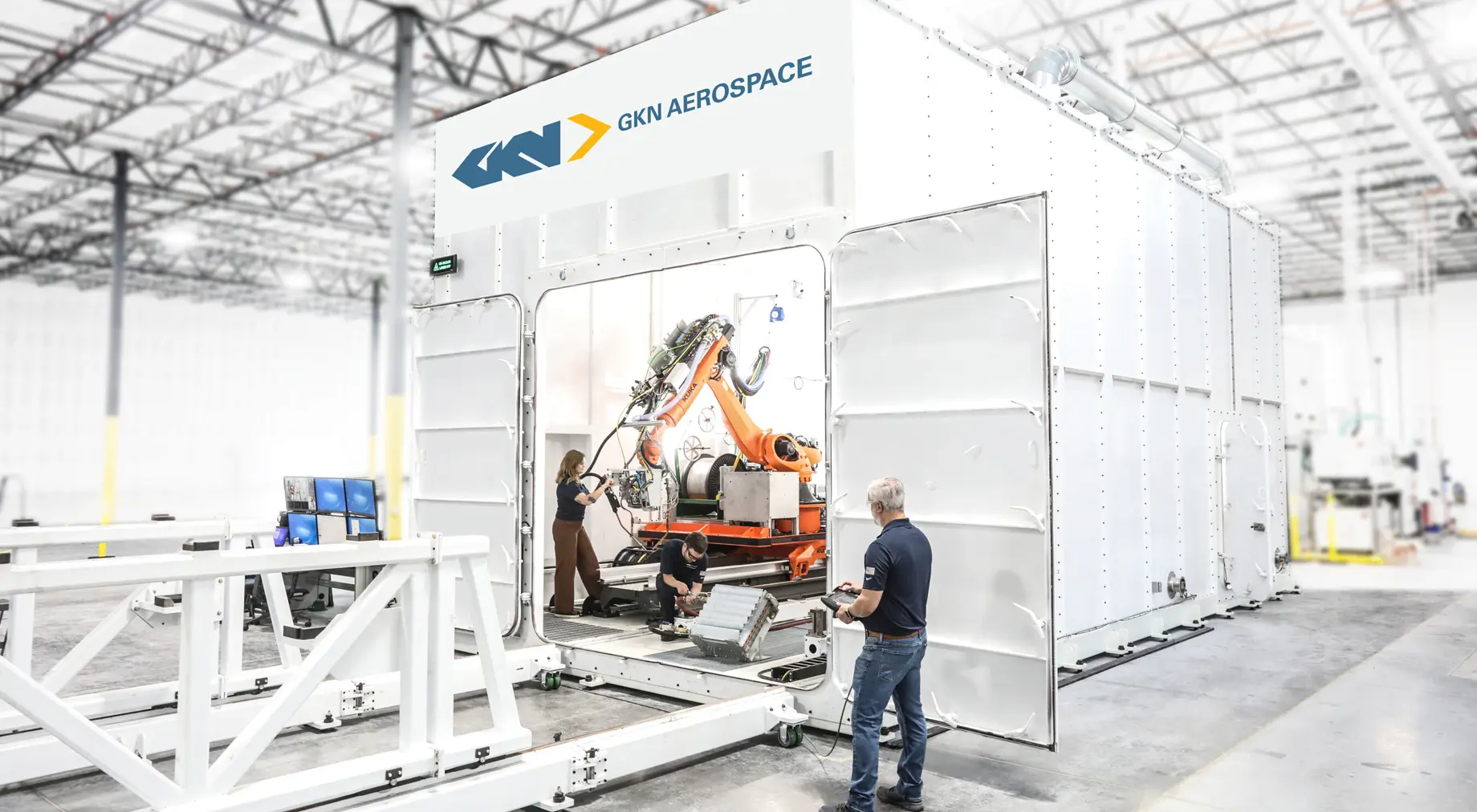
All program activity will be carried out at GKN Aerospace’s Global Technology Centre in Fort Worth, Texas, a facility already well established as a nerve center for manufacturing partnerships with U.S. defense and aerospace stakeholders.
GKN Aerospace’s Global Technology Centre. Photo via GKN Aerospace.
“TITAN-AM represents a significant step forward in additive manufacturing for aerospace structures. By combining our deep manufacturing expertise with AFRL’s vision, we aim to accelerate the readiness of LMD-w technology and demonstrate its value on operational titanium structural components,” said David Bond, CTO Airframes for GKN Aerospace.
From Lab to Flight: A Proven Track Record
GKN Aerospace brings over two decades of additive manufacturing experience to the program and holds an established position in large-scale 3D printed aerospace structures. According to the company, adopting LMD-w at scale is expected to lower material waste, compress production timelines, and open up greater geometric freedom for intricate components.
The company already manufactures the fan case mount ring for the American aerospace company Pratt & Whitney GTF (Geared Turbofan) engine family through additive processes at sites in both Sweden and the United States, with those parts currently in service on the Airbus A220 and Embraer E195-E2.
The Strategic Case for Taking Wire Printing to Production
Aerospace manufacturers no longer treat large-format titanium printing as a future ambition, they are actively qualifying and scaling it. Titanium defines the structural backbone of modern aircraft precisely because of its strength-to-weight ratio and corrosion resistance, yet conventional machining wastes enormous quantities of the material. Wire-based laser deposition solves that problem at the source: by building near-net-shape components layer by layer, LMD-w slashes t
DIRECT2026年4月17日
美空军启动TITAN-AM计划:增材制造助力战机供应链
3D打印工业增材制造领域权威技术与行业资讯平台