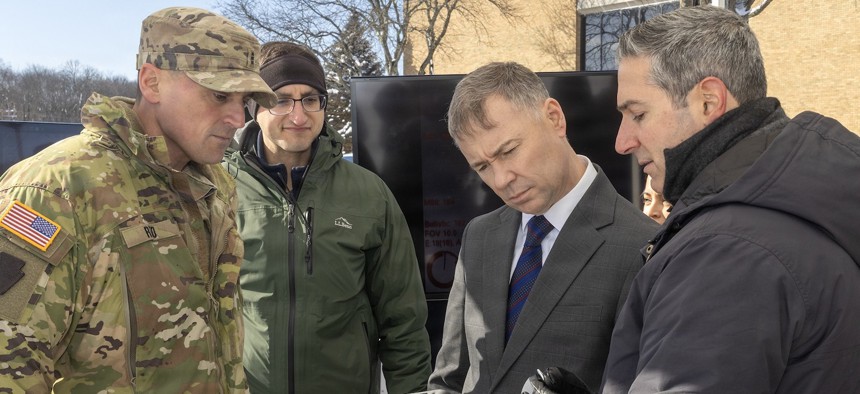
Chief Warrant Officer 3 Robert Reed, left, of the Pennsylvania National Guard Unmanned Aircraft Systems Training and Innovation Facility, takes part a UAS demonstration Jan. 20, 2026, at Picatinny Arsenal, New Jersey.
U.S. Army / Todd Mozes
April 16, 2026 06:01 PM ET
Army
Drones
NASHVILLE—A group of soldiers from the Pennsylvania Army National Guard is teaming up with the Army Research Laboratory to develop a prototype enemy drone recovery system that won the innovation award at the Army’s first Best Drone Warfighter competition in February. The idea came together over a “couple beverages” after Chief Warrant Officer 3 Robert Reed and his 28th Infantry Division Innovation Team got the invitation to enter the competition late last year, he told an audience Thursday at the Army Aviation Warfighter Summit. “So we wanted to come up with something that wasn't just the run-of-the-mill, Army-type system, something that industry would be excited about and potentially be able to take and make it scale from there,” he said.They came up with Project RED—Recovery Exploitation Drone—an unmanned system that uses AI to find downed enemy drones, and an attached robot arm to pick up those drones and fly them back to the unit to download their data. “We're currently working with Army Research Laboratory at this time to kind of refine our product, create more autonomy, more stability in the flight controls,” Reed said. It’s part of a one-year research-and-development agreement with ARL. Other units are already starting to work on their pitches for next year, Reed said as part of a panel discussing lessons learned from the first Best Drone Warfighter competition.He suggested creating sub-categories for the “best innovation” award with different budget thresholds, to give units of varying size and resources more room to develop their ideas. He was joined by Sgt. Javon Purchner and Staff Sgt. Angel Caliz, who won the best drone operator and best team portions of the competition.Purchner, a fire support specialist, brought several years as a first-person view drone hobbyist to the competition, he said. He suggested units give soldiers more designated time to train on drones.“At installations, have actual courses for soldiers that want to compete,” he said. “They can have time to actually go out and practice their flying skills and have that time set aside for them, because flying FPV drones isn't just as easy as picking up the controller and flying. It's something that takes a lot of time and practice to become proficient at.”Purchner’s leaders were so impressed with his skills that they plucked him from his unit in 1st Cavalry Division to serve at III Corps headquarters and develop a training center with multiple levels of courses to train new drone pilots at Fort Hood, Texas.Caliz said he’d been practicing the hunter-killer drone mission with his fellow 2nd Cavalry Regiment soldiers, giving him an edg
DIRECT2026年4月17日
美国陆军研发新型无人机回收系统:实现敌方硬件完整捕获
防务一号关注美国国防与国家安全的技术媒体