太空拦截弹成本过高,美军“金穹”防御系统面临预算挑战
“金穹”导弹防御系统的项目负责人周三表示,天基拦截弹的成本可能过高,即使是对于预算庞大的“金穹”系统而言也是如此。
美国太空军上将迈克尔·盖特林在众议院军事委员会战略部队小组委员会上承认,建造和部署用于在飞行早期击落敌方导弹的武装卫星可能永远无法负担。这是对特朗普总统在第二任期初期签署的行政命令的回应。
他表示:“我们今天不知道的是,我能否大规模且经济地完成这项工作?这将是助推段拦截面临的巨大挑战。因为我们非常关注负担能力,如果无法负担,我们就不会投入生产。”
2025年的行政命令明确要求“开发和部署”助推段空间拦截弹,尽管国防预算分析师和物理学家一直指出,该技术对于项目的预期成本和雄心来说过于昂贵甚至无效。
目前,“金穹”系统最近上调的造价为 1850 亿美元,其中 175 亿美元将由美国国防部 2027 财年的预算请求支持。其中大部分资金来自“预算调节”程序,这是一种仅需简单多数即可通过的特殊预算流程。
尽管预算调节不能保证未来年份的资金,但国防开支分析显示,“金穹”资金可能会在未来数年内包含在基础预算中。
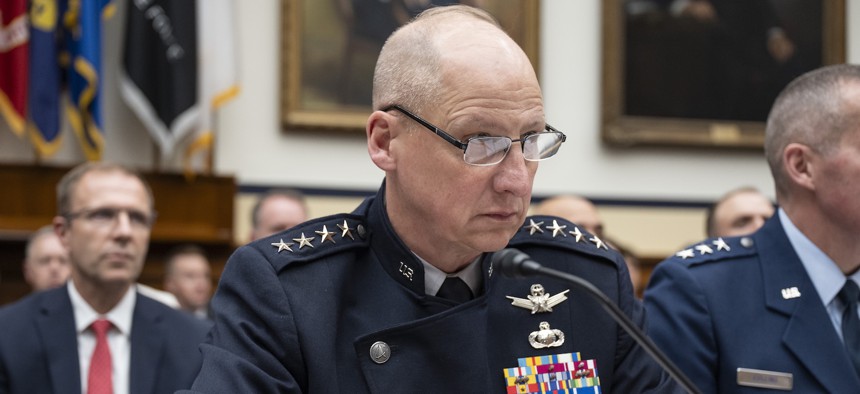
Gen. Michael Guetlein, program manager for Golden Dome, speaks before the House Armed Services Subcommittee FY27 missile defense and missile defeat programs and activities hearing, April 15, 2026.
Getty Images / Luke Johnson
April 16, 2026 03:55 PM ET
Space
Space Force
White House
Space-based interceptors may be too costly even for the massively budgeted Golden Dome missile defense system, the program’s leader said Wednesday. Acknowledging what many analysts have said ever since President Trump ordered up orbiting interceptors in one of the first executive orders of his second term, Space Force Gen. Michael Guetlein told the House Armed Services Strategic Forces subcommittee on Wednesday that building and deploying satellites armed to down enemy missiles early in flight may never be affordable. “What we do not know today is ‘can I do it at scale and can I do it affordably?’ That’s going to be the huge challenge for boost-phase intercept,” he said. “I will tell you because we are so focused on affordability. If we cannot do it affordabl[ly] we will not go into production.”Trump’s 2025 executive order that established the missile defense system explicitly calls for the “development and deployment” of boost-phase space interceptors, even though defense budget analysts and physicists have continuously pointed out that the technology would be too expensive and even ineffective for the project’s desired cost and ambitions. The recently increased $185 billion price tag for Golden Dome would be supported by $17.5 billion in the Defense Department’s 2027 budget request. Most of that is coming from reconciliation spending, a special budget process that requires a simple majority to pass mandatory legislation.Even though reconciliation isn’t a guarantee for future years, defense spending analysis shows that Golden Dome funds will likely be included in the baseline budget for several years. Baseline Golden Dome spending is estimated to be $14.7 billion in 2028 and rise to $16 billion by 2031, according to data from the American Enterprise Institute’s budget data navigator. Todd Harrison, a senior fellow at AEI, said that’s a big deal and shows there’s support for the project outside of abnormal spending bills.“They actually roll it into the base budget in future years; they don’t stay dependent on reconciliation,” Harrison said. “That’s been one of the big lingering questions.”Trump said last year that the system would intercept “very close to 100 percent” of a wide-range of missile threats, although his most recent defense budget request acknowledged that “the goal is to not create a 'perfect' defense.”During Wednesday’s hearing, Rep. Seth Moulton, D-Mass., said Trump “probably thinks himself a greater theorist of strategic deterrence than everyone else” and that a limited missile defense system would be more feasible.“It is clear to me now that the reality does not match w