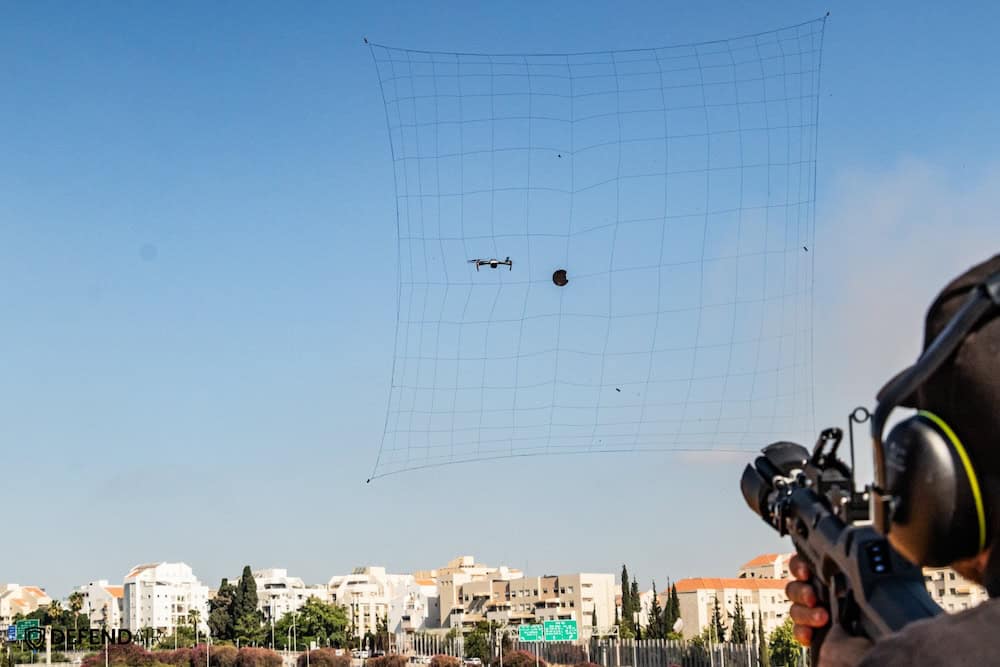
Wrap Technologies has outlined a strategic research and development initiative focused on net-based drone capture technologies to expand its non-lethal response platform into aerial interdiction.
The initiative builds on existing Kevlar-based cassette technology, originally developed for the BolaWrap platform, and extends this architecture into new aerial payload configurations. These configurations are being developed to support the safe interdiction of Unmanned Aerial System (UAS) threats in complex environments, including populated areas and sensitive infrastructure, where traditional counter-UAS approaches may present elevated operational and collateral risk.
The current research and development roadmap includes several key focus areas:
Net-based payloads designed for the aerial capture and entanglement of target drones.
Adaptation of Kevlar cord systems to support broader capture geometries and dynamic engagement scenarios.
Multi-payload drone configurations intended to enable multiple capture opportunities within a single sortie.
Scalable cassette designs to support different mission profiles across law enforcement, corrections, and critical infrastructure security environments.
By utilizing physical capture rather than destructive defeat, the approach may offer several potential advantages, including avoidance of radio frequency interference in communications-sensitive civilian environments and reduced risk of uncontrolled debris over populated areas. The company believes this modular approach can support faster iteration across multiple deployment formats without introducing unnecessary complexity.
Drone Capture Nets
Discover cutting-edge solutions from leading global suppliers
SUPPLIER SPOTLIGHT
The initiative reflects a broader non-lethal response strategy focused on applying non-lethal control concepts to emerging operational environments where agencies require safer, more precise, and more accountable intervention options. As human-machine interaction becomes a more significant part of public safety and security operations, the company states that such interactions should begin with non-lethal response.
The development roadmap also includes concepts intended to support multi-drone interdiction from a single platform. The ability to deploy multiple net payloads in sequence or rapid succession is intended to improve mission flexibility and support operational readiness in environments involving repeated or coordinated drone incursions.
The expansion into aerial interdiction represents a further step in delivering non-lethal response as a system rather than a standalone tool. The company states that public safety requires more than a device-only solution, particularly as drone-enabled operations and autonomous systems continue to expand. The R&D roadmap is intended to support the extension of safer, lawful, and more scalabl
BROWSER2026年4月17日
“网捕”无人机:美军工企业研发新型空中拦截技术
无人系统技术全球无人机及无人化装备领域专业媒体