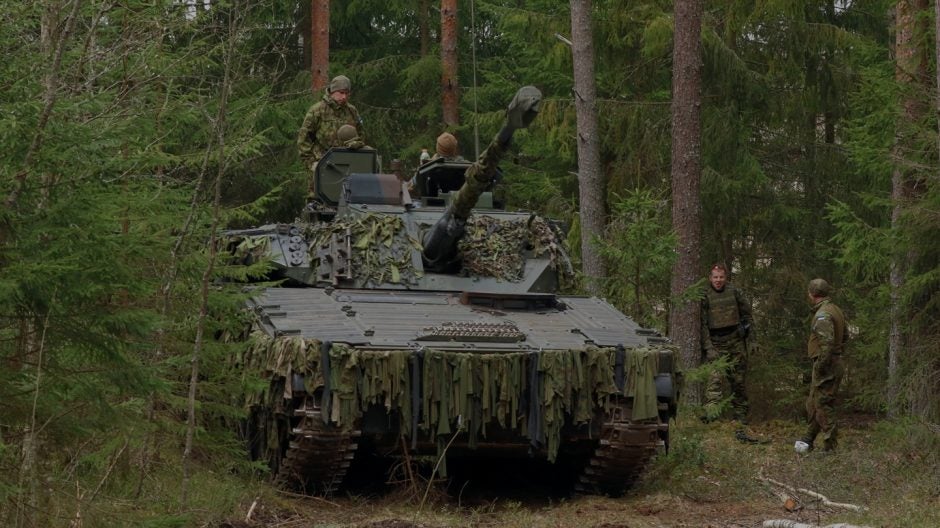
塔林方面早前曾计划用更现代化的平台更换现有的CV9035NL步兵战车(IFV),但近期决定将投资转向其他领域。
爱沙尼亚取消新型步兵战车采购;将斥资约1亿欧元升级44辆CV9035NL
- 超过4亿美元的额外资金可能转向反无人机系统(C-UAS)和FPV无人机
- 装甲运兵车交付将于2025年完成;国防开支将增至16亿美元以上
爱沙尼亚已放弃原定采购新型步兵战车的计划,该计划旨在更换目前的CV90平台,并将资金重新导向替代能力的采购,据推测可能是反无人机系统和FPV自杀式攻击无人机。根据GlobalData的库存数据,爱沙尼亚运营着一支由44辆CV9035NL步兵战车组成的机队,这些车辆是在2016年至2019年期间从BAE系统公司采购的。
2025年,爱沙尼亚与芬兰、挪威、瑞典、立陶宛和荷兰签署了一项协议,探讨将CV90 Mk IV作为现役9035NL型号的潜在替代方案。然而,爱沙尼亚国防投资中心发言人告诉《陆军技术》,这一决策现在发生了逆转,44辆CV9035NL将接受价值1亿欧元(约1.178亿美元)的升级包。
该发言人表示:“目前,对现有步兵战车进行现代化改造比更换它们更为合理。现代化将确保能力的持续保存和资源的高效利用。”该发言人补充说,剩余的分配资金(总额预计超过4亿美元)目前尚未分配,仍有待分析。外界普遍认为,这笔资金将流向反无人机系统和FPV攻击无人机系统,这些系统已被证明在乌克兰具有战术和战略影响力。业内人士也证实,爱沙尼亚正重新分配资金,重点关注无人机系统,而非装甲车辆。
Tallinn had earlier planned to replace the existing CV9035NL IFVs with a more modern platform but has recently opted to invest elsewhere.
An Estonian CV90 IFV on exercise in 2021. Credit: US Army photo by 1st Lt. Ian Fischer
Estonia cancels new IFV buy; will upgrade 44 CV9035NLs for ~€100m
Extra funds (> $400m) likely shift to counter-UAS and FPV drones
APC deliveries completed in 2025; defence spending rising to >$1.6bn
Estonia has dropped its intended acquisition of new infantry fighting vehicles (IFV), intended to replace a fleet of current CV90 platforms, and redirect funding to the procurement of alternative capabilities, thought potentially to be counter-UAS and FPV strike drones.
According to GlobalData’s inventory data lists, Estonia operates a fleet of 44 CV9035NL IFVs, acquired during 2016-2019, produced by BAE Systems AB.
In 2025 Estonia signed a deal with Finland, Norway, Sweden, Lithuania, and the Netherlands to explore the CV90 Mk IV as a possible replacement to the in-service 9035NL variants, with other IFV available internationally also to be considered.
However, the reversal will now see the 44 CV9035NL receive a €100m ($117.8m) upgrade package, an Estonian Center for Defence Investments spokesperson told Army Technology.
“At present, it is more rational to modernise the existing infantry fighting vehicles rather than replace them. Modernisation will ensure the sustained preservation of capability and the efficient use of resources,” the spokesperson said.
Continuing, the spokesperson said that the remaining allocated funds, which is thought to total in excess of $400m, was still unallocated, pending analysis.
However, it is thought likely that the pivot will be towards counter-UAS and FPV strike drone systems, which have provided to have both a tactical and strategic influence in Ukraine.
Industry insiders separately told Army Technology that Estonia is reallocating funds to focus on UAS instead of armoured vehicles.
Meanwhile Estonia confirmed that it had completed delivery of both Otokar ARMA 6×6 APCs and Nurol Machina NMS 4×4 APCs, all of which arrived in 2025.
“More specifically, the [Estonian] Defence Forces currently have 133 Otokar vehicles and 96 Nurol vehicles in active use, while four Nurol vehicles were delivered to the Estonian Rescue Board,’’ the spokesperson said.
Estonia defence spending doubles
In Nato’s recent publication of member defence spending, Estonia’s estimated defence spend for 2025 was in excess of $1.6bn, nearly double the $820m figure for 2022. As a percentage of GDP, this reflected 3.42% of the country’s total expenditure, an increase from 2.14% in 2022.
A Strategic Intelligence report from GlobalData in 2025 revealed that investment in defensive c-UAS capabilities would accelerate, with the capability increasingly being seen as essential given the proliferation of drones in the battlespace.
Additional reporting by John Hill.