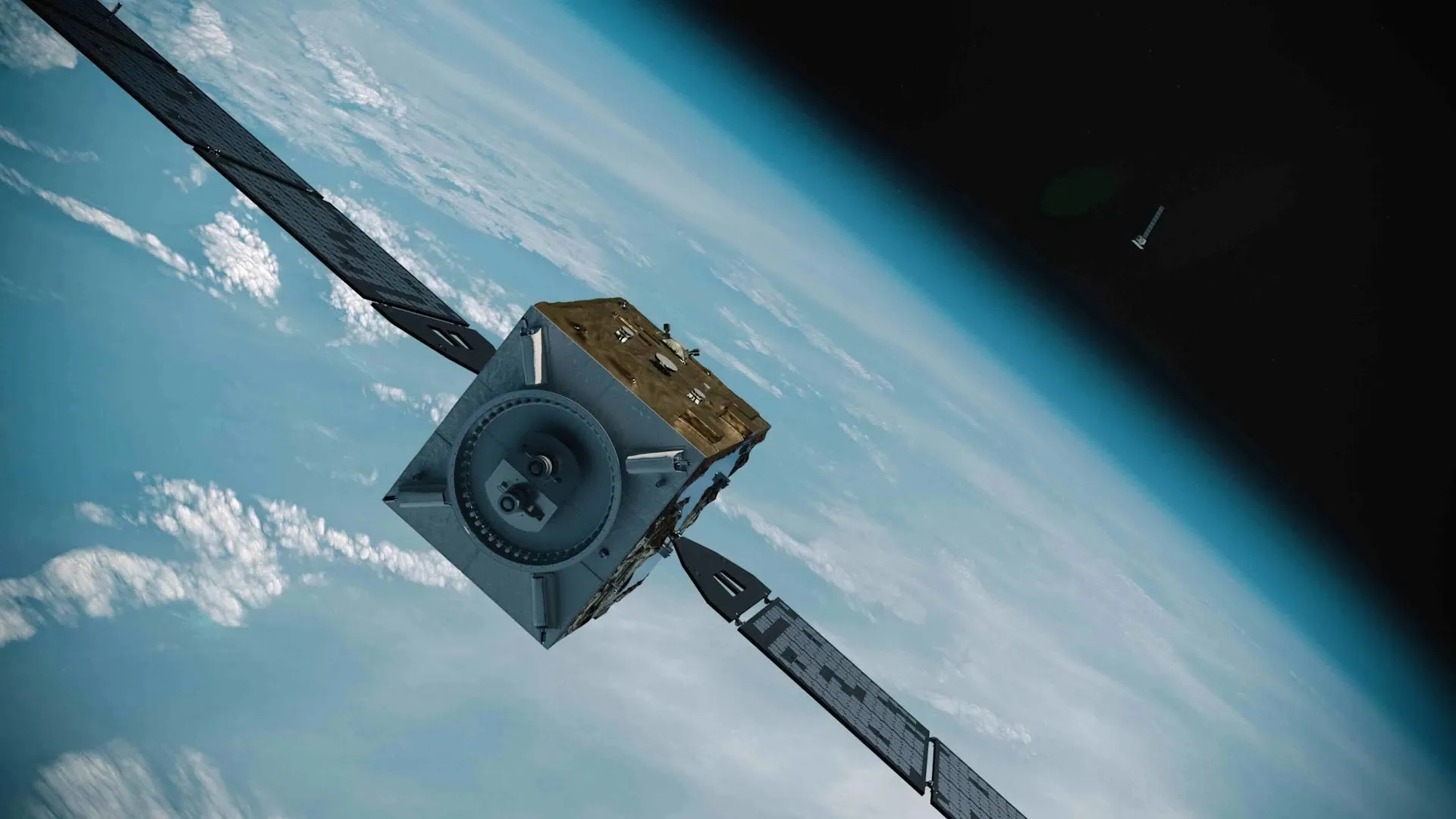
日本空间可持续发展公司 Astroscale 公布了一项任务计划,称其将成为世界上第一个在不同轨道视察多个废弃卫星的任务。
该任务名为“日本现场空间态势感知-1”(ISSA-J1),计划于 2027 年发射,将视察日本在轨的两颗退役卫星。此前,该公司的 ADRAS-J 任务已成功获取了在轨废弃火箭级的惊人近距离图像。
“在轨视察提供了从地面无法获得的关于卫星状态的关键见解,”Astroscale 日本公司执行董事冈田信武在声明中表示。“通过在单一任务中视察不同轨道的多个目标,ISSA-J1 将有助于展示支持卫星运营商了解航天器状况并为未来服务做准备的新能力。”
目标卫星是 2006 年发射的高级陆地观测卫星(ALOS)和 2002 年发射的高级地球观测卫星-II(ADEOS-II)。发射后,ISSA-J1 航天器将逐渐靠近 ALOS,从一定距离开始观察,然后移动进行近距离视察。随后,ISSA-J1 将转移到另一个轨道,对 ADEOS-II 重复这一过程。
ALOS 大约有一辆公共汽车那么大,质量约为 4000 公斤。该卫星于 2011 年失去动力,但仍处于平均高度 691 公里的近极地轨道。ADEOS-II 质量稍轻,为 3700 公斤,处于约 806 公里的更高近极地轨道。由于太阳能电池板故障,该任务在不到一年后结束。
通过这一序列,ISSA-J1 将展示在单一任务中接近不同轨道多个目标的能力。
Artist's illustration of Astroscale's ISSA-J inspection mission in Earth orbit.
(Image credit: Astroscale)
Japanese space-sustainability company Astroscale has unveiled plans for a mission it says will be the world's first to inspect multiple defunct satellites in different orbits.The mission, named In‑situ Space Situational Awareness-Japan 1, or ISSA-J1, is scheduled for launch in 2027 and will inspect two retired Japanese satellites in orbit. It follows the success of the company's Active Debris Removal by Astroscale-Japan (ADRAS-J) mission, which delivered stunning close-up footage of a spent rocket stage in orbit."On-orbit inspection provides critical insight into the condition of satellites that cannot be obtained from the ground," said Nobu Okada, managing director of Astroscale Japan, in a statement. "By inspecting multiple objects in different orbits in a single mission, ISSA-J1 will help demonstrate new capabilities that support satellite operators in understanding spacecraft condition and preparing for future servicing."The targeted satellites are the Advanced Land Observing Satellite (ALOS), launched in 2006, and the Advanced Earth Observing Satellite‑II (ADEOS‑II), launched in 2002. Once launched, the ISSA-J1 spacecraft will gradually approach ALOS, beginning observations at a distance before moving in for a closer inspection. ISSA-J1 will then transition into another orbit to repeat the process with ADEOS-II.ALOS is about the size of a bus with a mass of around 8,800 lbs (4,000 kg). The satellite lost power in 2011 but remains in a near-polar orbit with an average altitude of 429 miles (691 kilometers). ADEOS‑II is slightly less massive at 8,150 lbs (3,700 kg) but in a higher near-polar orbit of around 500 miles (806 km) above Earth. The mission ended after less than a year due to the failure of a solar panel."Through this sequence, ISSA‑J1 will demonstrate the ability to approach multiple clients in different orbits within a single mission, repeating a cycle of approach, inspection, departure and orbital transition," Astroscale said in a statement.Breaking space news, the latest updates on rocket launches, skywatching events and more!Astroscale was selected for the on-orbit inspection demonstration mission by the Japan Ministry of Education, Culture, Sports, Science and Technology as part of its Small and Business Innovation Research program. It is part of an effort to advance Japan's space situational awareness and in-orbit servicing capabilities.The company is also scheduled to launch the ELSA-M orbital debris removal demonstration mission no earlier than 2027 in partnership with Germany's Isar Aerospace. The launch startup is currently preparing for its second-ever launch of its Spectrum launcher at Andøya Spaceport in northern Norway.
Andrew is a freelance space journalist with a focus on reporting on China's rapidly growing space sector. He began writing for Space.com in 2019 and writes for SpaceNews, IEEE Spectrum, National Ge