[By Frank Bell]
The Strait of Hormuz does not need to be made safe to reopen global shipping. It only needs to be made governable. Even as the United States has begun striking selected Iranian military targets—including recent operations against military facilities on Kharg Island—the fundamental challenge in the Gulf remains unchanged: restoring predictable commercial transit through a contested maritime chokepoint without triggering a broader regional war.
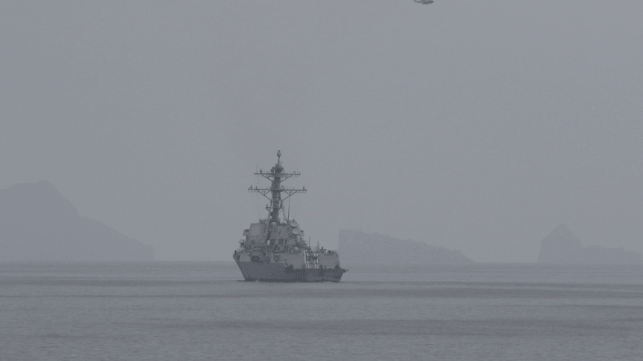
Attempts to eliminate every Iranian capability that could threaten shipping would require a prolonged campaign across the Persian Gulf. A more practical approach is to establish a temporary defended transit corridor, concentrating naval escort, airborne surveillance, shipborne helicopter protection, and a limited southern-shore defensive node into a narrow and defensible passage through the strait.
For months, analysts have treated the Strait of Hormuz as if it were either completely safe or completely impassable. In reality, maritime chokepoints rarely function in such absolute terms. Shipping does not require a perfectly safe ocean. It requires a corridor that is predictable, defensible, and credible enough for commercial operators and insurers to accept the risk.
The debate surrounding the Strait of Hormuz often assumes that the only way to restore shipping is to eliminate Iran’s ability to threaten the waterway. That assumption leads immediately to the prospect of a large regional war—air campaigns against coastal missile batteries, naval battles across the Gulf, and months of escalation.
But history suggests a different path. During past maritime crises, naval powers have frequently restored commerce not by eliminating every threat but by establishing managed transit systems that compress risk into a narrow and controllable space.
The solution for Hormuz may therefore lie not in dominating the entire Persian Gulf but in creating a temporary defended corridor through the chokepoint.
Such a corridor would rely on a layered structure of naval escort, airborne surveillance, close maritime protection, and a small defensive presence on the southern side of the strait. The goal would not be to make the Gulf harmless. The goal would be to make passage governable.
A surface escort layer would provide command and air-defense protection for merchant vessels approaching the chokepoint. Overhead surveillance aircraft and supporting fighter coverage would maintain a continuous operational picture, allowing rapid response to emerging threats. Shipborne helicopters would monitor the corridor closely, investigating suspicious vessels and countering small craft or unmanned surface threats.
One of the most important—and most overlooked—components of such a system would be a small but visible defensive node on the southern side of the strait, operating in cooperation with regional partners. Positioned near the tip of the chokepoint, this element would provide persistent radar coverage, counter-UAS capabilit
DIRECT2026年4月17日
美军打击伊朗境内军事设施,计划在霍尔木兹海峡设立护航走廊
海事执行官全球领先的航运与海事专业分析媒体