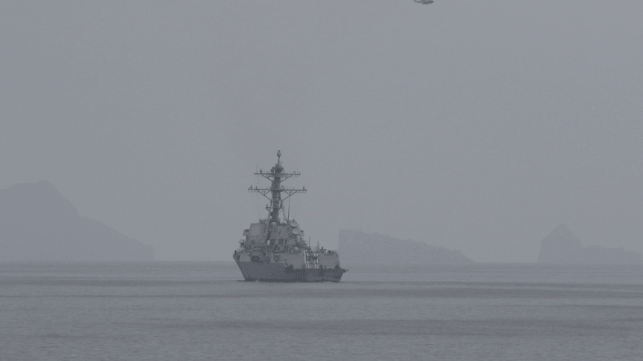
霍尔木兹海峡无需完全安全即可重启全球航运,它只需要变得“可治理”。尽管美国已经开始打击选定的伊朗军事目标——包括近期对哈尔克岛军事设施的行动——但海湾地区的核心挑战依然未变:即如何在不引发更大规模地区战争的情况下,恢复通过这一竞争激烈的海上咽喉要道的商贸运输。
试图完全消除伊朗威胁航运的能力将需要在波斯湾开展长期的军事行动。一种更务实的方法是建立临时的防御转运走廊,将海军护航、空中监视、舰载直升机保护以及有限的南岸防御节点集中到穿过海峡的一条狭窄且可防御的通道中。数月来,分析人士一直倾向于将霍尔木兹海峡视为绝对安全或绝对无法通行的。实际上,航运并不需要完美的海洋环境,它只需要一个足够预测、可防御且可信的走廊,以使商业运营商和承保人接受风险。历史经验表明,海军力量通常不是通过消除所有威胁,而是通过建立受控的过境系统来压缩风险,从而恢复商业运作。因此,解决霍尔木兹问题的方案不在于统治整个海湾,而在于在该咽喉地带创建一个受保护的过境走廊。
[By Frank Bell]
The Strait of Hormuz does not need to be made safe to reopen global shipping. It only needs to be made governable. Even as the United States has begun striking selected Iranian military targets—including recent operations against military facilities on Kharg Island—the fundamental challenge in the Gulf remains unchanged: restoring predictable commercial transit through a contested maritime chokepoint without triggering a broader regional war.
Attempts to eliminate every Iranian capability that could threaten shipping would require a prolonged campaign across the Persian Gulf. A more practical approach is to establish a temporary defended transit corridor, concentrating naval escort, airborne surveillance, shipborne helicopter protection, and a limited southern-shore defensive node into a narrow and defensible passage through the strait.
For months, analysts have treated the Strait of Hormuz as if it were either completely safe or completely impassable. In reality, maritime chokepoints rarely function in such absolute terms. Shipping does not require a perfectly safe ocean. It requires a corridor that is predictable, defensible, and credible enough for commercial operators and insurers to accept the risk.
The debate surrounding the Strait of Hormuz often assumes that the only way to restore shipping is to eliminate Iran’s ability to threaten the waterway. That assumption leads immediately to the prospect of a large regional war—air campaigns against coastal missile batteries, naval battles across the Gulf, and months of escalation.
But history suggests a different path. During past maritime crises, naval powers have frequently restored commerce not by eliminating every threat but by establishing managed transit systems that compress risk into a narrow and controllable space.
The solution for Hormuz may therefore lie not in dominating the entire Persian Gulf but in creating a temporary defended corridor through the chokepoint.
Such a corridor would rely on a layered structure of naval escort, airborne surveillance, close maritime protection, and a small defensive presence on the southern side of the strait. The goal would not be to make the Gulf harmless. The goal would be to make passage governable.
A surface escort layer would provide command and air-defense protection for merchant vessels approaching the chokepoint. Overhead surveillance aircraft and supporting fighter coverage would maintain a continuous operational picture, allowing rapid response to emerging threats. Shipborne helicopters would monitor the corridor closely, investigating suspicious vessels and countering small craft or unmanned surface threats.
One of the most important—and most overlooked—components of such a system would be a small but visible defensive node on the southern side of the strait, operating in cooperation with regional partners. Positioned near the tip of the chokepoint, this element would provide persistent radar coverage, counter-UAS capabilit