Iran has no Navy, no Air Force, and no realistic path to defeating the U.S. Navy in a conventional fight. Its weapons against the blockade are Shahed drone swarms, small boat attacks from underground facilities, up to 30 explosive mini-submarines — and time itself, used as a weapon against American political will.
Iran’s Plan to Beat America: Just Survive?
This week, U.S. President Donald Trump ordered a blockade of the Strait of Hormuz in response to Iran’s allowing ships through the blockade of the waterway.
The largest risk with the blockade begins and ends with three clear combat realities: meaning suicide drones, mini-submarines, and small boat attacks are the main weapons Iran would likely use to challenge the U.S. Navy blockade in the Strait of Hormuz.
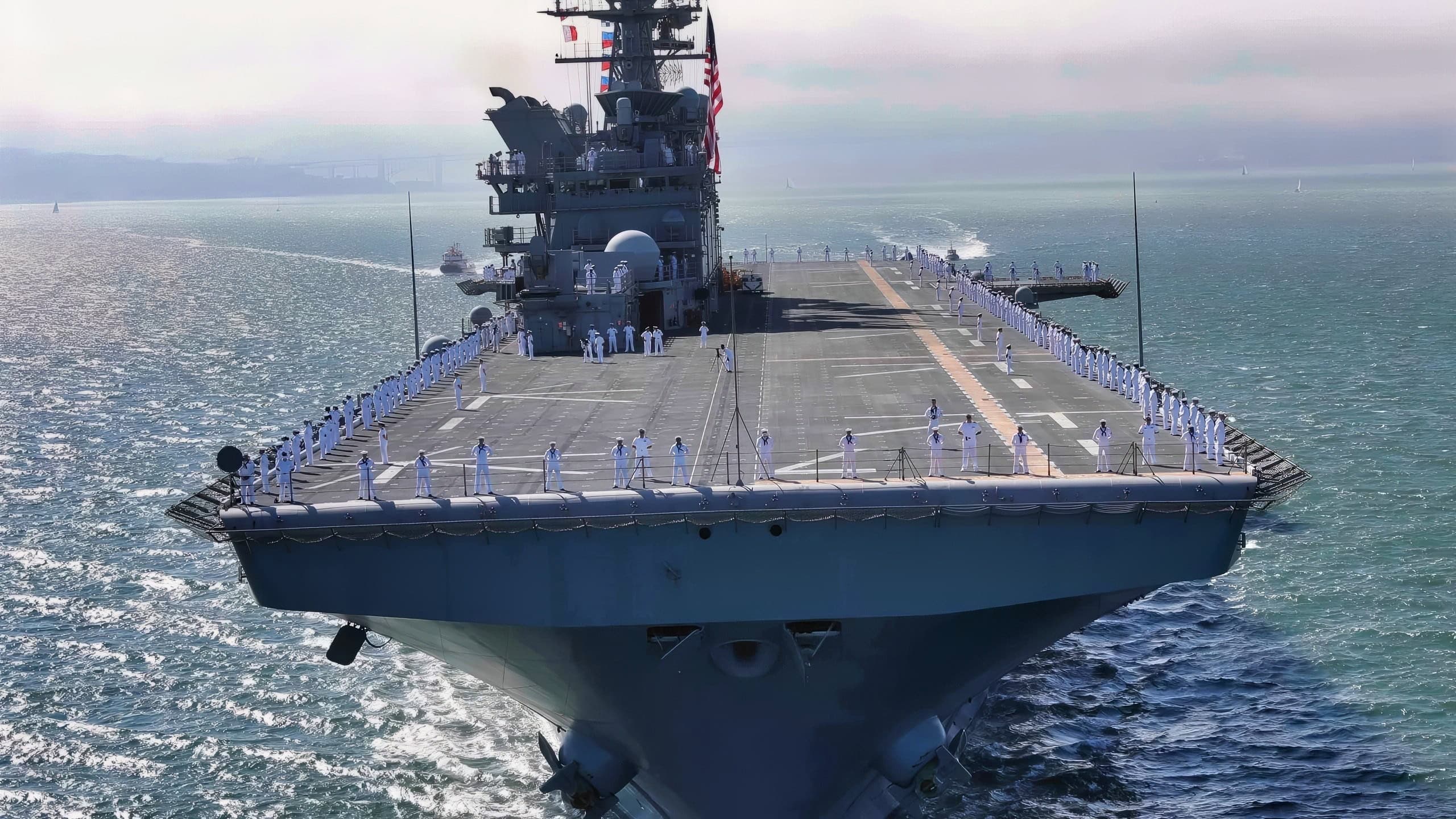
210911-N-OP825-1213 PACIFIC OCEAN (Sept. 11, 2021) Sailors aboard amphibious assault ship USS Tripoli (LHA 7) man the rails on the ship’s flight deck as the ship prepares to pull into San Francisco in support of San Francisco Fleet Week (SFFW), Sept. 11, 2021. SFFW is an opportunity for the American public to meet their Navy, Marine Corps and Coast Guard teams and experience America’s sea services. During fleet week, service members participate in various community service events, showcase capabilities and equipment to the community, and enjoy the hospitality of San Francisco and its surrounding areas. (U.S. Navy photo by Mass Communication Specialist 3rd Class Erica Higa /Released)
Ballistic missiles would be easily tracked and intercepted by warships, and Iran has no more Navy or Air Force with which to mount an attack on the U.S. Navy.
U.S. Navy warships are armed with an integrated system called the Aegis Combat System, which uses radar, command and control, and ship-launched interceptors to track and destroy incoming ballistic missile attacks at sea.
Aegis radar proved extremely successful in the Red Sea when Houthi drones and cruise missiles attacked U.S. Navy ships, as the Navy operated with a “perfect” defensive record.
Houthi forces hit some commercial ships, but no missiles landed on U.S. Navy ships, and the service has now rapidly integrated new drone-defense weapons for maritime combat.
Iranian Shahed Drone Swarms
The threat of Shahed drones resides mostly in the concept of swarm, meaning an overwhelming number of drones.
U.S. Marines, with the 31st Marine Expeditionary Unit (MEU), transport ordinance on the flight deck of America-class amphibious assault ship USS Tripoli (LHA 7), Mar. 20, 2026. Tripoli is currently underway conducting routine operations in the U.S. 7th Fleet area of operations. U.S. 7th Fleet, is the U.S. Navy’s largest forward-deployed numbered fleet, routinely interacts and operates with allies and partners in preserving a free and open Indo-Pacific. (U.S. Navy photo by Mass Communication Specialist Seaman Apprentice Reese Mitchell Taylor)
A single suicide drone is very likely to be spotted from air, ground, and surface ship sensors and be intercepted or destr
DIRECT2026年4月17日
美媒分析:若霍尔木兹海峡爆发冲突 伊朗导弹难敌美军拦截
1945专注美国防务与国家安全的专业评论网站