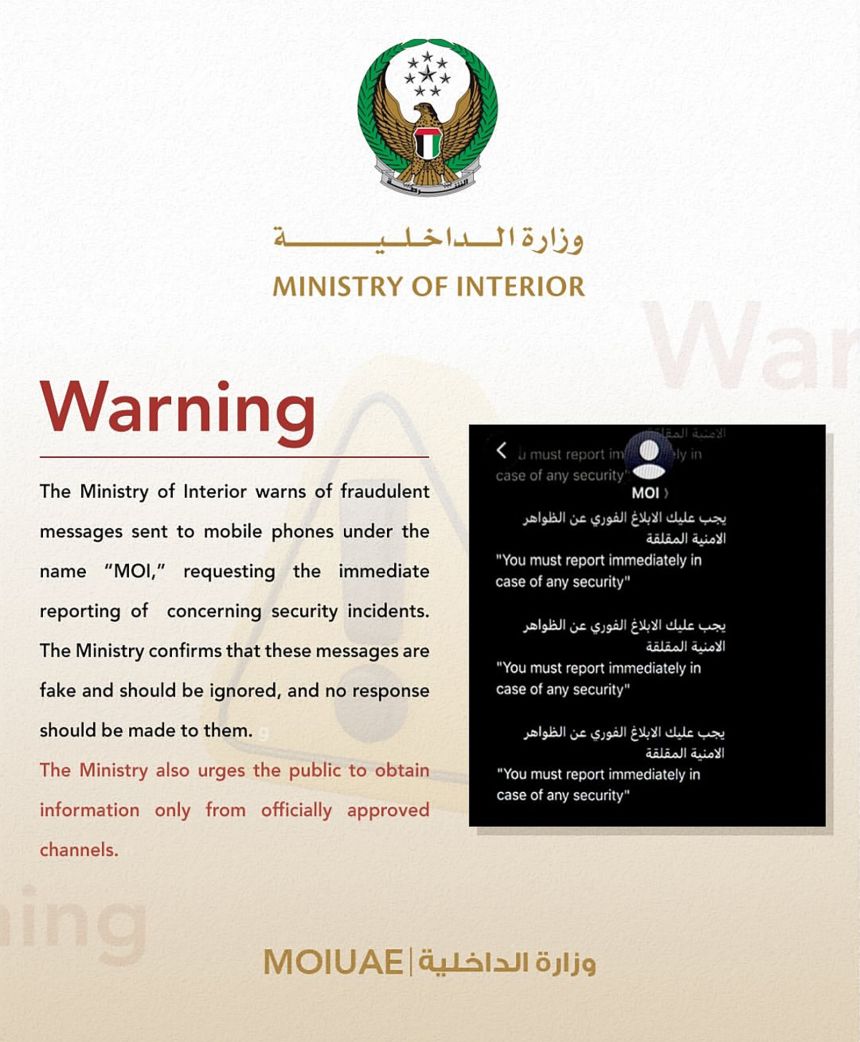
“You must report immediately in case of any security incident,” read a text message sent to phones in the United Arab Emirates from “MOI” during the Iran war. But the country’s Ministry of Interior never sent such an alert. It later cautioned residents against acting on the “fake” message.
In a country that bore the brunt of Iranian attacks as Tehran retaliated against Israel and the United States, authorities say the nation also faced barrages of a more insidious nature.
The UAE had already noticed a sharp spike in cyberattacks weeks before the war, Mohamed Al Kuwaiti, the head of cybersecurity for the UAE Government, told state media last month. In the early days of the war, he said, cyber-attacks from Iranian proxies grew to 500,000 a day, mostly targeting critical infrastructure
“After the (war began) the internet was cut (in Iran) yet their proxies continued (attacking us) from…outside of Iran,” he said. “Many people received phishing emails asking people to click on links…which began as data gathering and then transformed to become destructive.”
During the war, Iran and its proxies launched thousands of missiles and drones at as many as 12 American-allied states in retaliation against US-Israeli strikes on its territory. But it’s on the less visible front – the psychological and information war – where Tehran has had an outsized impact.
Threatening text messages purporting be from Iran’s Revolutionary Guards told Israelis to “wait for death” as evacuation orders – mimicking the Israeli military’s controversial style used in Gaza and Lebanon – urged civilians near critical infrastructure and major residential neighborhoods in Gulf Arab states to leave.
Attacks on web servers early March disrupted banking systems in the United Arab Emirates and Bahrain, halting financial transactions and everyday banking activities. Iran’s Revolutionary Guards announced a hit list of American companies and universities operating in the Middle East - including Meta, Oracle, Nvidia, Microsoft, and Google – forcing many to ask staff to work from home.
Paolo Napolitano, associate director at Dragonfly from Dow Jones, a geopolitical and security risk firm based in London, said that cyber operations and influence campaigns are now an integral part of modern warfare, and Iran as well as Iran-linked actors made extensive use of these during the conflict with the US and Israel.
The economic opportunities in countries like Saudi Arabia, Qatar and the UAE have long attracted foreign businesses seeking access to lucrative markets, capital and low taxes. Global talent has flocked to the nations that have for decades been seen as islands of stability in a volatile region.
Iran’s campaign takes aim at this carefully cultivated image, aiming to inflict reputational damage – even if the physical damage is minimal.
“Iran was under no illusion that it would be
DIRECT2026年4月17日
伊朗对中东对手发起全方位心理与网络战
有线电视新闻网全球领先的24小时新闻广播媒体