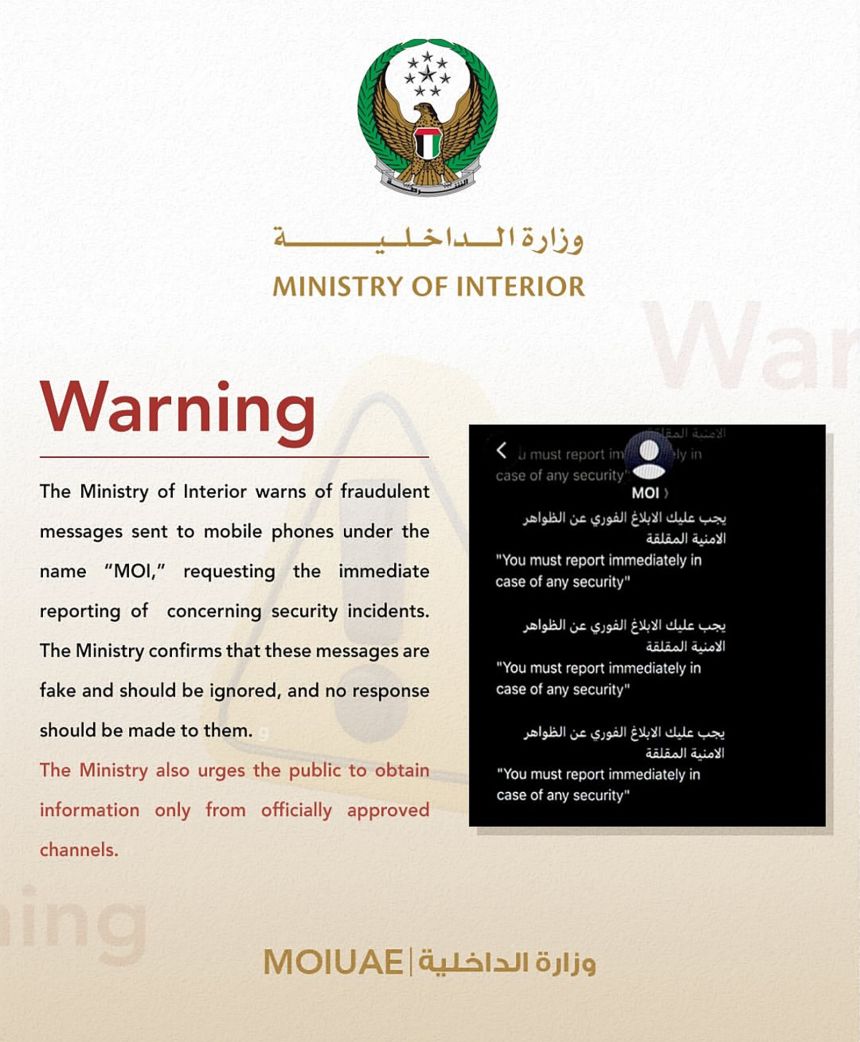
“如遇任何安全事件,必须立即报告,”在伊朗战争期间,阿联酋居民的手机收到了署名为“MOI”(内政部)的短信。然而,该国内政部从未发送过此类警报,随后提醒居民切勿对这些“虚假”信息采取行动。
在德黑兰针对以色列和美国实施报复行动期间,阿联酋首当其冲受到了伊朗攻击。当局表示,该国还面临着一系列更为阴险的攻势。阿联酋政府网络安全主管穆罕默德·库威提上月告诉官方媒体,早在战争爆发前几周,该国就注意到网络攻击激增。在战争初期,来自伊朗代理人的网络攻击增加到每天50万次,主要针对关键基础设施。
他表示:“战争开始后(伊朗境内)互联网被切断,但其代理人继续从伊朗境外(攻击我们)。许多人收到了钓鱼邮件,要求点击链接,这起初是数据搜集,随后演变为破坏性攻击。”
战争期间,伊朗及其代理人向多达12个美国盟友国家发射了数千枚导弹和无人机,以报复美国和以色列对其领土的打击。但在不太明显的阵地——心理和信息战中,德黑兰产生了更大的影响。自称来自伊朗革命卫队的威胁短信告诉以色列人“等待死亡”,而模仿以色列军方在加沙和黎巴嫩使用的撤离命令,则敦促海湾阿拉伯国家关键基础设施和主要住宅区附近的平民离开。
3月初对网络服务器的攻击扰乱了阿联酋和巴林的银行系统,导致金融交易和日常银行业务陷入停滞。伊朗革命卫队还宣布了一份针对美国公司的打击名单。
“You must report immediately in case of any security incident,” read a text message sent to phones in the United Arab Emirates from “MOI” during the Iran war. But the country’s Ministry of Interior never sent such an alert. It later cautioned residents against acting on the “fake” message.
In a country that bore the brunt of Iranian attacks as Tehran retaliated against Israel and the United States, authorities say the nation also faced barrages of a more insidious nature.
The UAE had already noticed a sharp spike in cyberattacks weeks before the war, Mohamed Al Kuwaiti, the head of cybersecurity for the UAE Government, told state media last month. In the early days of the war, he said, cyber-attacks from Iranian proxies grew to 500,000 a day, mostly targeting critical infrastructure
“After the (war began) the internet was cut (in Iran) yet their proxies continued (attacking us) from…outside of Iran,” he said. “Many people received phishing emails asking people to click on links…which began as data gathering and then transformed to become destructive.”
During the war, Iran and its proxies launched thousands of missiles and drones at as many as 12 American-allied states in retaliation against US-Israeli strikes on its territory. But it’s on the less visible front – the psychological and information war – where Tehran has had an outsized impact.
Threatening text messages purporting be from Iran’s Revolutionary Guards told Israelis to “wait for death” as evacuation orders – mimicking the Israeli military’s controversial style used in Gaza and Lebanon – urged civilians near critical infrastructure and major residential neighborhoods in Gulf Arab states to leave.
Attacks on web servers early March disrupted banking systems in the United Arab Emirates and Bahrain, halting financial transactions and everyday banking activities. Iran’s Revolutionary Guards announced a hit list of American companies and universities operating in the Middle East - including Meta, Oracle, Nvidia, Microsoft, and Google – forcing many to ask staff to work from home.
Paolo Napolitano, associate director at Dragonfly from Dow Jones, a geopolitical and security risk firm based in London, said that cyber operations and influence campaigns are now an integral part of modern warfare, and Iran as well as Iran-linked actors made extensive use of these during the conflict with the US and Israel.
The economic opportunities in countries like Saudi Arabia, Qatar and the UAE have long attracted foreign businesses seeking access to lucrative markets, capital and low taxes. Global talent has flocked to the nations that have for decades been seen as islands of stability in a volatile region.
Iran’s campaign takes aim at this carefully cultivated image, aiming to inflict reputational damage – even if the physical damage is minimal.
“Iran was under no illusion that it would be