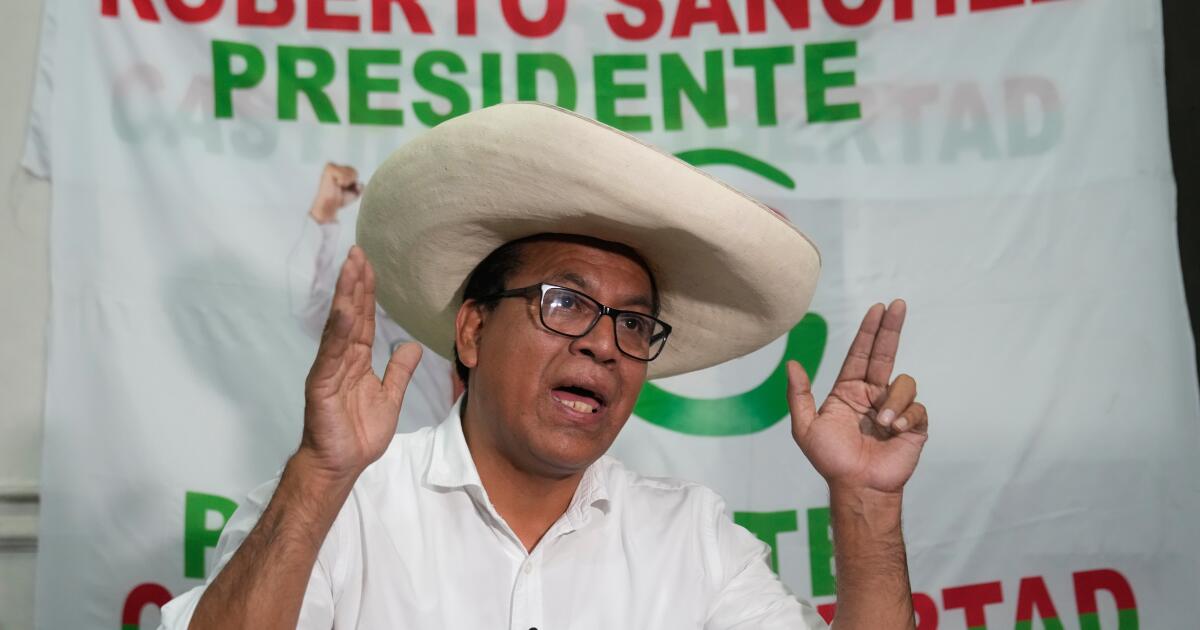
秘鲁利马报道——周四的总统大选计票结果显示,二三名之间的竞争极其激烈,可能需要数周时间才能确定进入6月决选的最终名单。目前,与入狱的前总统结盟的民族主义议员罗伯托·桑切斯,以及承诺恢复死刑的超保守派政客拉斐尔·洛佩斯·阿里亚加,正争夺与藤森庆子对阵的机会。
在已统计的93%选票中,藤森庆子以17.06%领先,但需参加决选。紧随其后的是桑切斯(11.97%)和阿里亚加(11.91%),两人差距仅8000余票。他们的政治主张南辕北辙:桑切斯常戴着标志性的农民草帽,承诺进行重大经济变革,包括扩大政府支出、税收改革及部分自然资源国有化;阿里亚加则是前利马市长,专注于强硬的安全议程,提议在亚马逊地区兴建监狱、允许匿名审判并驱逐非法外国人。目前还有约1600份来自偏远村庄和海外的计票表以及5000份有争议的报表待处理,选举法院正面临漫长的上诉程序。
LIMA, Peru — Results Thursday from Peru’s presidential election showed such a tight race for second and third place that it could take weeks to finalize the top two candidates for the country’s required runoff election in June.A nationalist congressman allied with an imprisoned former president and an ultraconservative politician who promises to reinstate the death penalty are top contenders to face Keiko Fujimori, who was virtually assured of taking the top slot among the 35 candidates in Sunday’s election.With 93% of the ballots tallied, official results on Tuesday showed Fujimori, the conservative daughter of disgraced former President Alberto Fujimori, leading the count with 17.06%, though far below the required 50% needed to avoid a runoff. Behind her, Roberto Sánchez, a nationalist congressman and former minister under imprisoned ex-President Pedro Castillo, earned 11.97%. Trailing narrowly in third place was Rafael López Aliaga, the ultraconservative former mayor of Peru’s capital, Lima, with 11.91%.Suspense mounted over who would advance to the June 7 runoff, with the margin between Sánchez and López Aliaga closer than 8,000 votes in the most recent results.They couldn’t be more different politically.Sánchez, frequently seen in the wide-brimmed peasant hat that has become his trademark, has promised major economic changes, including a dramatic expansion of government spending, an extensive reform of the tax system and partial nationalization of Peru’s natural resources. López Aliaga, the ultraconservative former mayor of Peru’s capital, Lima, focuses on a hard-line security agenda, proposing to build prisons in the country’s Amazon region, allowing judges to conceal their identities and expelling foreigners who are living illegally in Peru.The narrow margin is compounded by approximately 1,600 pending tally sheets from remote villages and abroad. Additionally, another 5,000 sheets have been challenged, leaving the electoral courts with an appeals process that could take weeks to resolve.“In Peru, a percentage of tally sheets are always ‘challenged’ due to potential mathematical errors,” explained Álvaro Henzler, president of Transparencia, a democracy-watchdog group that deployed 4,000 observers. “When this occurs, they are sent to 60 special electoral boards for review.”In 2021, Peru’s electoral tribunal proclaimed first-round results 37 days after the April 11 vote. At that time, however, the gap between the second-place contenders exceeded 238,000 votes from the start, leaving little room for suspense. “In this case, since the race is so tight, the contested tally sheets could end up altering the standings; that is why it is taking longer,” Henzler noted.A presidential candidate needs more than 50% of votes to win outright. The two candidates with the most votes in a first round advance to the runoff on June 7.The winner will be Peru’s ninth president in just 10 years and will replace José María Balcázar, who was elected interim presid