白宫启动了一项协调一致的联邦倡议,旨在太空中部署核反应堆,指示美国国家航空航天局(NASA)和国防部开展裂变系统的并行设计竞赛,这些系统可在本十年末为月球基地和太空任务提供动力,并要求能源部(DOE)支持燃料供应、基础设施和技术开发。
由白宫科学和技术政策办公室(OSTP)于4月14日发布的《第3号国家太空技术备忘录》(NSTM-3)正式启动了“美国太空核动力国家倡议”,并为在轨道和月球上部署中低功率太空反应堆以及在2030年代部署更高功率系统设定了近期时间表。
该备忘录要求NASA在30天内启动一个开发中功率太空反应堆的计划,包括一个计划在2030年前发射的月球裂变表面动力变体,以及一个支持核电推进演示的空基系统选项。与此同时,能源部必须在60天内评估美国核工业基地在五年内生产多达四个太空反应堆的就绪情况,并就解决任何差距提供建议。
该指令指出,联邦政府迫切需要为月球和深空任务建立可靠、连续的动力源,并在商业和国家安全对空基核系统兴趣日益浓厚的背景下,加速开发进程。开发太空核动力系统的联邦努力已进行了多年,但在2020年,NASA和能源部开始正式寻求月球裂变表面动力系统,这建立在早期的Kilopower反应堆演示基础之上。
The White House has launched a coordinated federal initiative to deploy nuclear reactors in space, directing NASA and the Department of War (DOW) to run parallel design competitions for fission systems that could power lunar bases and in-space missions by the end of the decade, and tasking the Department of Energy (DOE) to support fuel supply, infrastructure, and technical development.
National Space Technology Memorandum‑3 (NSTM-3), issued April 14 by the White House Office of Science and Technology Policy (OSTP), formally launches the National Initiative for American Space Nuclear Power and sets near‑term timelines for low‑ to mid‑power space reactors in orbit and on the Moon, as well as a higher‑power system in the 2030s.
The memo gives NASA 30 days to initiate a program to develop a mid-power space reactor, including a lunar fission surface power variant targeted for launch by 2030 and an option for a space-based system to support a nuclear electric propulsion demonstration. In parallel, the DOE must, within 60 days, assess the readiness of the U.S. nuclear industrial base to produce up to four space reactors within five years and provide recommendations to address any gaps.
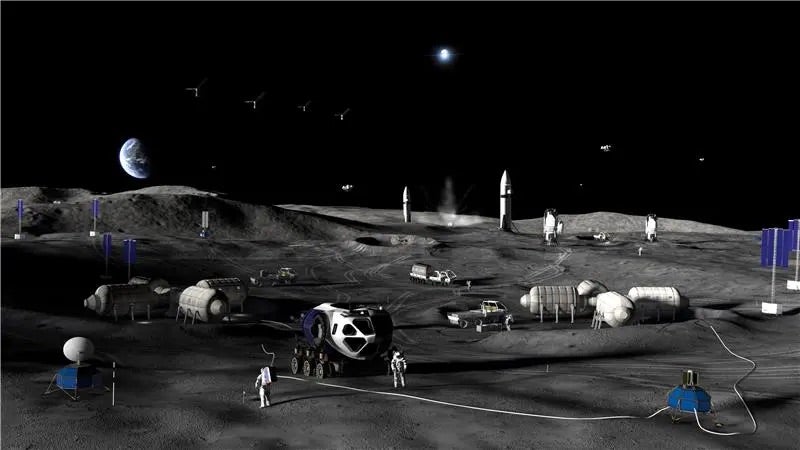
Artist’s concept of NASA’s planned lunar base, showing surface habitats, power and mobility systems that would support a sustained human presence at the Moon’s south pole. Source: NASA
Nuclear for Space: Years in the Making
The directive points to a growing urgency within the federal government to establish reliable, continuous power sources for lunar and deep-space missions, as well as to accelerate development timelines amid increasing commercial and national security interest in space-based nuclear systems.
Federal efforts to develop space-based nuclear power systems have been underway for years, but progress has been uneven. In 2020, NASA and the Department of Energy began formally pursuing a lunar fission surface power system, building on earlier Kilopower reactor demonstrations and decades of small-reactor research. As POWER reported at the time, the effort marked the start of a U.S. push to develop a reactor capable of supporting sustained operations on the Moon. More recently, renewed attention to lunar nuclear power—driven by Artemis mission planning, rising power demands, and intensifying global competition in space—has reinforced the role of fission systems as a long-duration, reliable energy source for off-world applications.
On Dec. 18, 2025, notably, the White House issued Executive Order 14369, “Ensuring American Space Superiority,” which directed the federal government to enable “near-term utilization of space nuclear power by deploying nuclear reactors on the Moon and in orbit, including a lunar surface reactor ready for launch by 2030.” The order called for Americans’ return to the Moon by 2028 and the establishment of initial elements of a permanent lunar outpost by 2030, and it explicitly tasked OSTP with coordinating a National Initiative for American