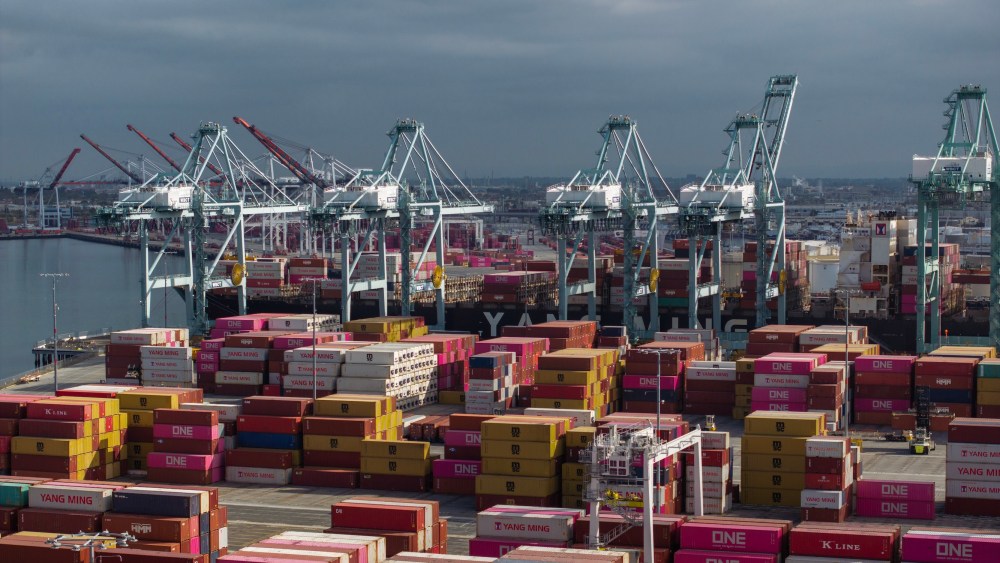
Port of Long Beach terminal operators handled 774,935 20-foot equivalent units (TEUs) of cargo last month, a 5.2 percent decline from March 2025 container handling numbers, mirroring the slower throughput from its sister gateway, the Port of Los Angeles.
Like the L.A. port, the Long Beach hub has seen no direct impacts from the war in Iran, in that it hasn’t been the catalyst for the reduced cargo volumes. But Port of Long Beach CEO Noel Hacegaba indicated during a Wednesday media briefing that “global supply chain pressures are indeed mounting” due to the Middle East conflict.
Imports last month declined 1.6 percent to 374,412 TEUs when compared to prior-year numbers, while exports showed a 0.5 percent uptick to 104,554 TEUs. Empty containers moving through the port dropped 11.1 percent to 295,970 TEUs.
Like many major U.S. seaports, the L.B. gateway is enduring a tough year-over-year baseline comparison against last March, when importers front-loaded cargo ahead of April’s Liberation Day tariffs.
But the tough comparisons did not stop the port’s dockworkers from handling the highest total number of TEUs in North America, both for March and the first quarter. Across January through March, nearly 2.4 million TEUs passed through the terminals at the Port of Long Brach, representing a 5.7 percent drop year over year.
During the briefing, Jonathan Gold, vice president of supply chain and customs policy at the National Retail Federation (NRF), noted that the forecast for imports at major U.S. container ports is expected to remain below last year’s levels for at least the first half of 2026.
While Gold concurred that the ports will not be significantly impacted by the Iran war, the rising fuel costs due to the constriction of traffic through the Strait of Hormuz could eventually effect retailers and consumers.
As retailers aim to be nimble as the situation in the Middle East unfolds, small-to-medium-sized businesses (SMBs) are feeling a disproportionate hit to their business due to the elevated costs, he
“Retailers already operate on an extremely slim margin, and small businesses in particular don’t have the ability to absorb cost increases and typically have to pass those along to the the end consumer,” Gold said. “Certainly, the smaller retailers are more impacted by some of these immediate changes than larger companies are.”
Hacegaba noted that the rerouting of ships to avoid the conflict zone is setting off a chain reaction resulting in longer routes, further amplifying the cost increases.
“Ultimately, consumers pay more,” the port CEO said.
However, the consumer has been resilient despite the price increases.
“We still see a strong consumer demand in 2026,” Gold said, citing NRF’s annual projections of a 4.4 percent retail sales increase in 2026. “The consumer remains the bright spot in our economy despite all the various policy and geopolitical challenges that we’ve faced.”
According to Gold, the NRF was “pleased” with the Federal M
DIRECT2026年4月17日
伊朗战事冲击全球供应链:长滩港吞吐量出现下滑
女装日报专注于时尚与零售业供应链分析的权威刊物