Mitsubishi Heavy Industries (MHI) has been awarded a contract by Japan’s Acquisition, Technology & Logistics Agency (ATLA) to build three upgraded Mogami-class multi-mission frigates (FFM), with a total contract value of 128.6 billion yen ($806 million). The award was recently disclosed by ATLA.
The three ships correspond to the third through fifth units of the new 4,800-ton-class FFM, an enhanced variant of the Japan Maritime Self-Defense Force’s (JMSDF) Mogami-class frigate—known in Tokyo as the “New FFM” and also called as the 06FFM.
The contract was signed on February 16, 2026, with MHI acting as the prime contractor. The new FFM is positioned as a core platform in the JMSDF’s next-generation surface fleet, building on the baseline Mogami-class design while incorporating enhanced mine countermeasure capabilities and improved unmanned systems integration.
Notably, the upgraded FFM is expected to feature significantly improved air defense and radar capabilities, bringing it closer in role and capability to a missile frigate (FFG). ATLA had previously awarded MHI a contract worth about 79.6 billion yen on March 27, 2025, for the construction of the first two ships of the class, making the latest award a follow-on order.
Budget vs. Contract Cost Gap
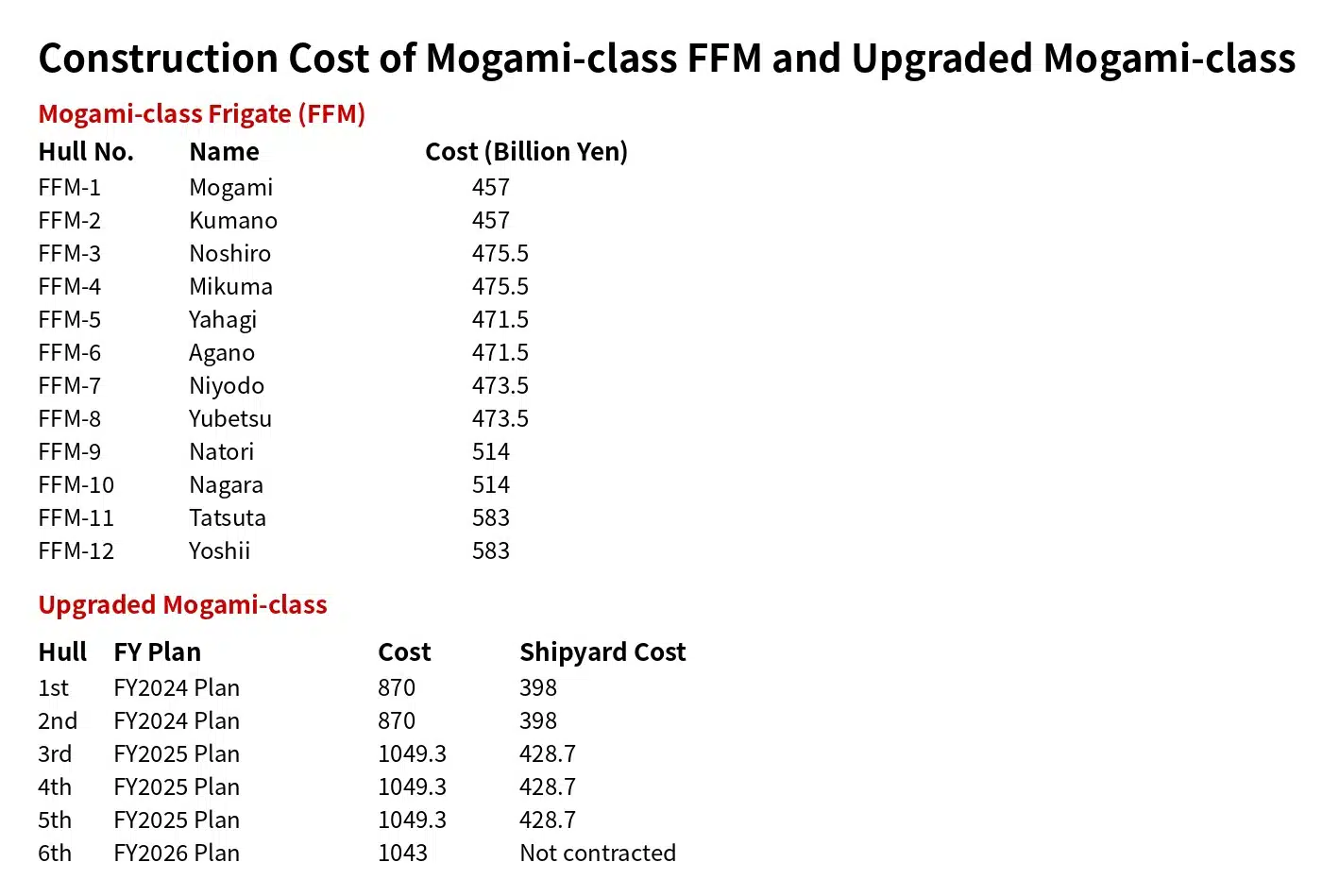
The 128.6 billion yen contract has drawn attention due to the apparent gap with Japan’s FY2025 defense budget. The budget allocated 314.8 billion yen for the same three ships (units 3–5), implying a per-unit cost of roughly 104.9 billion yen. By contrast, the contract value suggests a per-ship cost of about 42.8 billion yen, creating what appears to be a substantial discrepancy.
According to ATLA, however, the difference stems from the scope of the figures. The 314.8 billion budget yen allocation includes not only hull construction but also the procurement of onboard systems such as radar, sonar, and communications equipment. In contrast, the 128.6 billion yen contract covers only the shipyard portion—specifically hull construction—and excludes the cost of onboard systems. As such, the 42.8 billion yen figure reflects only the platform cost and not the total cost of a fully equipped warship.
This distinction highlights a common feature of modern defense procurement, where hull construction and mission systems are contracted separately. As sensor and combat system costs continue to rise, they represent an increasingly large share of total platform cost.
Rising Costs Driven by Inflation
Data from Japan’s Ministry of Defense and Maritime Staff Office indicate that the unit cost of both the Mogami-class and its upgraded successor has increased significantly in recent years.
Rising global material costs, currency depreciation, and inflation have all contributed to higher shipbuilding costs.
Upgraded Mogami-class Industrial Teaming: MHI and JMU
Under the procurement framework established through a 2023 competitive process, MHI serves as the prime contractor, with Japan Marine United (JMU) participating as a
DIRECT2026年4月17日
三菱重工获准为日本海上自卫队建造三艘改进型护卫舰
海军新闻全球海军装备与舰艇项目专业媒体,覆盖潜艇、水面舰艇、海战系统全谱系