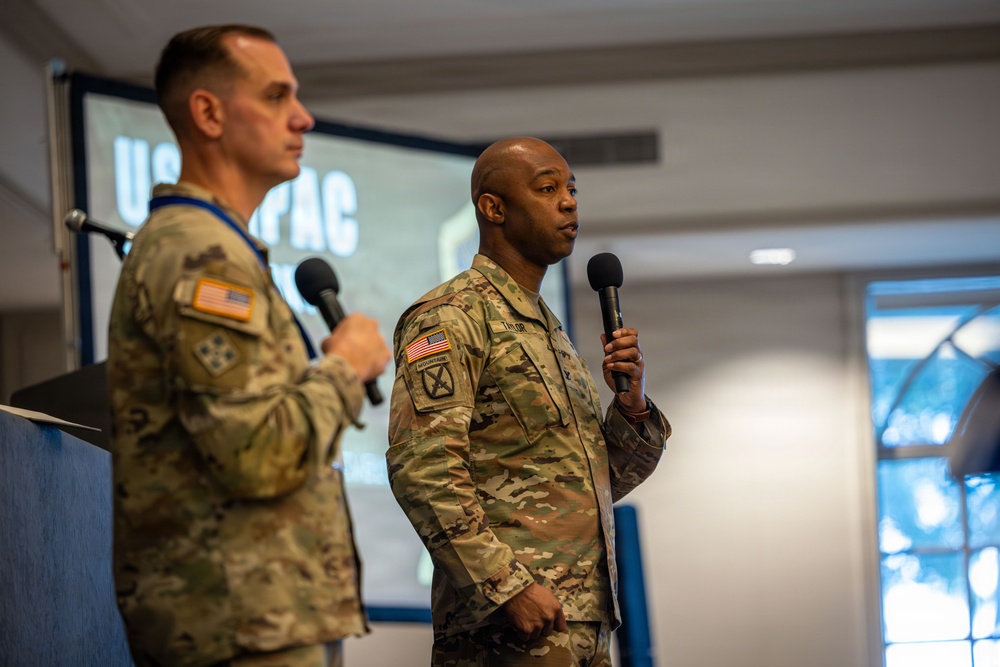
HONOLULU, Hawaii — U.S. Army Pacific (USARPAC) kicked off the Public Affairs Leadership Development Forum (PALDF), from March 29 through April 2, 2026, at the Hyatt Regency Waikiki Resort. Public Affairs professionals from across the Indo-Pacific were brought together for a weeklong forum focused on sharing best public affairs practices across the force.
“PALDF is important because it brings Public Affairs professionals together from across the Indo-Pacific to engage, inform, and educate. I believe these are the core responsibilities for PAOs to help their commands communicate effectively,” said Col. Isaac Taylor, USARPAC Public Affairs Director.
Taylor explained that the goal of Public Affairs is to inspire trust in the Army.
USARPAC leaders emphasized that winning doesn’t begin in conflict, winning begins with communication.
“We have to be present to win. There is no other option,” said Gen. Ronald P. Clark, USARPAC commanding general.
The forum included representatives from the White House, Department of State, U.S. Indo-Pacific Command, Headquarters, Department of the Army, theater Army major subordinate commands, sister services, U.S. embassies, and allied and partner nations.
“The benefit of hosting PALDF is ensuring that Public Affairs professionals from across the Theater are able to meet each other and network, taking the time to cultivate relationships that will enhance our strategic communications as a whole,” said Sgt. Maj. Andrew Porch, USARPAC Public Affairs senior enlisted advisor.
Designed to strengthen communication across the joint and multinational force, the forum focused on aligning public affairs efforts with whole-of-government objectives, higher headquarters priorities, and theater campaign plans.
“We want to reassure our allies and partners that they can rely on us and make sure our adversaries know our Soldiers are ready to answer the nation’s call,” said Taylor.
But beyond synchronization, leaders made it clear that storytelling is not just a supporting effort, it is a critical component of deterrence.
“If we don’t tell our story, no one else is going to tell our story," said Sgt. Maj. Jason Schmidt, USARPAC command sergeant major, “And in a theater as complex as this one, that matters.”
Spanning 17 time zones and encompassing more than 60 percent of the world’s population, the Indo-Pacific presents unique operational and informational challenges.
“Distance is our major operational challenge,” Clark said. “Our advantage is that we have allies who fight alongside us.”
That presence, leaders emphasized, extends beyond physical positioning, it also includes dominance in the information space.
“The first thing everyone does in the morning is pick up their phone. That's power,” said Schmidt. “You can solve problems with storytelling long before the rifleman has boots on the ground.”
Throughout the forum, attendees explored how public affairs supports theater objectives by shaping perceptions, strengthening partnerships, and
BROWSER2026年4月17日
美陆军太司令部:将“叙事能力”转化为亚太威慑力
DVIDS美国国防部旗下的官方军事新闻与多媒体分发平台