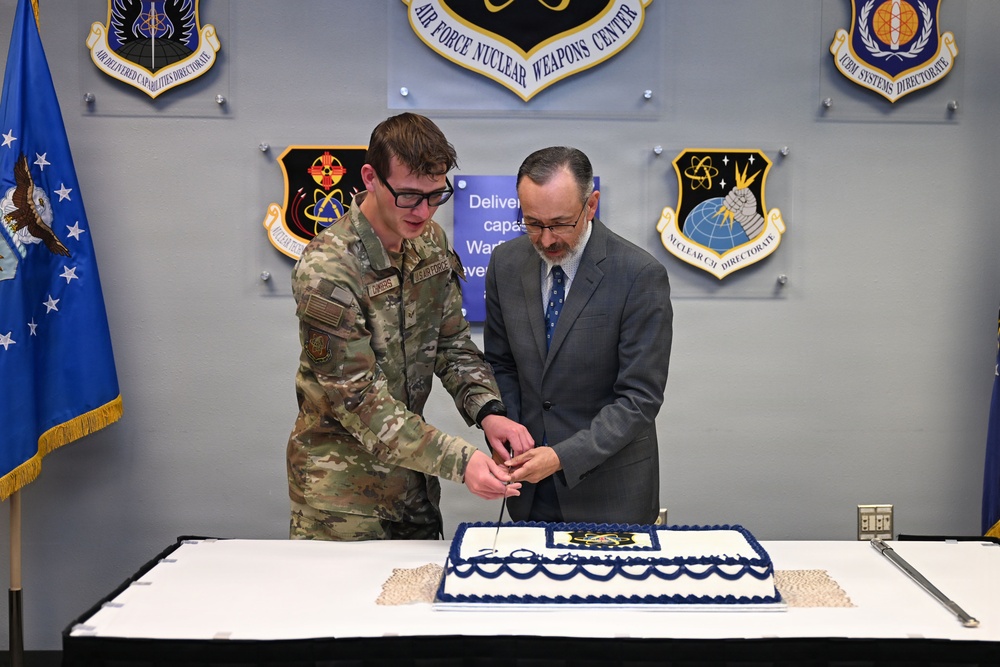
The Air Force Nuclear Weapons Center marks 20 years on March 31 of ensuring the nation’s most powerful weapon systems are “never doubted, always feared.”
“For the past 20 years, AFNWC has bolstered U.S. strategic deterrence by acquiring, sustaining, integrating and modernizing the nuclear capabilities our operators use every day to deter our adversaries and assure our allies and partners,” said Brig. Gen. William Rogers, interim commander of AFNWC. “When the center stood up, the responsibility and materiel management for these systems was dispersed throughout the Air Force. Today, our operators have a single organization dedicated to making sure our legacy systems still function as intended and our new weapon systems will meet their needs.”
The center synchronizes all aspects of nuclear materiel management on behalf of Air Force Materiel Command and in direct support of Air Force Global Strike Command. It is responsible for the sustainment of legacy weapon systems, some of which first became operational in the 1960s. It is also responsible for the acquisition programs to modernize and replace those legacy weapon systems and their support systems. These modernization programs include the Sentinel intercontinental ballistic missile; Long Range Standoff cruise missile; variants of the B61 nuclear gravity bomb; many nuclear command, control and communications systems; and weapons generation facilities.
On March 31, 2006, AFNWC was activated at Kirtland Air Force Base, New Mexico.
At the time of its activation, then Col. Greg Foraker, AFNWC’s first commander, said Kirtland was a natural place to locate the newest member of the nuclear community, since the base had been at the heart of nuclear activities for over 60 years at that point.
For example, one of the center’s predecessors, the Special Weapons Command, stood up in 1949 at Kirtland AFB. It directed specialized organizations dealing with atomic bombs and other unconventional weapons.
This command was later renamed the Air Force Special Weapons Center. During the 1950s and early 1960s, AFSWC personnel and aircraft participated in atmospheric nuclear tests in Nevada and the far Pacific. These included the first air drop of a U.S. thermonuclear weapon and the firing of the first air-to-air nuclear missile. In all, the Air Force Special Weapons Center was involved in more than 300 atmospheric nuclear tests in the Pacific and the test range in Nevada.
After AFSWC’s inactivation in 1976, nuclear acquisition and sustainment responsibilities were spread throughout several Air Force organizations.
In March 2006, [the Air Force established AFNWC](https://www.afnwc.af.mil/News/Article-Display/Article/2481788/nuclear-weapons-center-the-right-organization-at-the-right-time/) under Air Force Materiel Command to bridge the gap that had formed between the acquisition of nuclear weapons versus their sustainment in the field.
The [Nuclear Command, Control and Communications (NC3) Integration Directorate](https://
BROWSER2026年4月17日
美国空军核武器中心成立20周年:确保战略威慑力量始终可靠
DVIDS美国国防部官方视觉信息发布平台