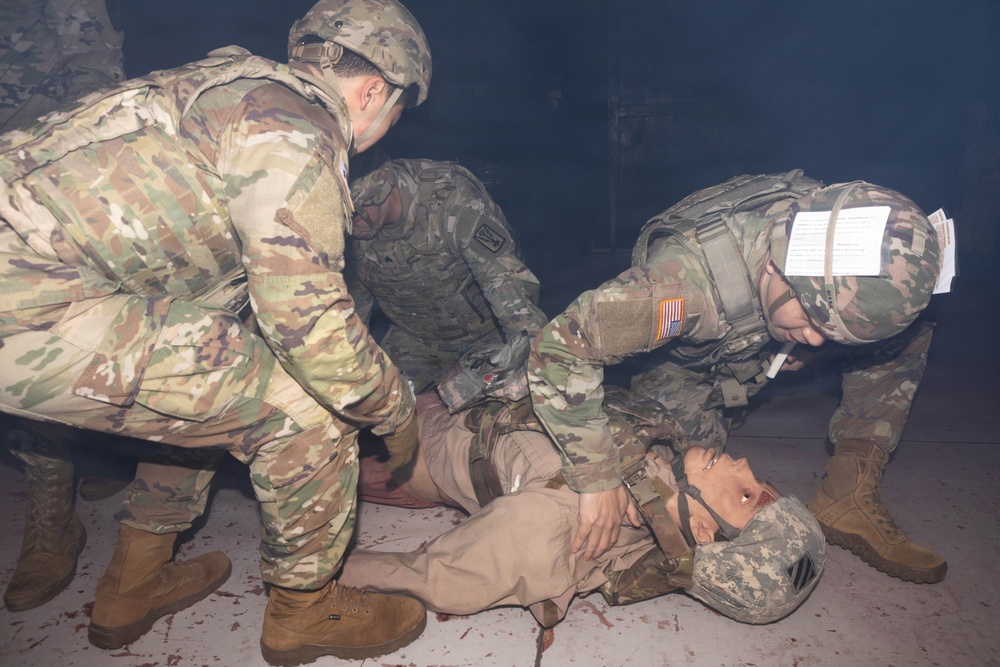
In a simulated combat scenario, Unit Ministry Teams (UMTs) from across the Korean Peninsula validated their role as combat multipliers during the annual Korea Theater of Operations (KTO) Strategic Religious Partnership Training (SRPT), April 13-15.
Hosted by the Eighth Army Chaplain Directorate, the training subjected U.S. Army Chaplains, Religious Affairs Specialists, Korean Augmentation Troops to the United States Army (KATUSA), and their Republic of Korea (ROK) Army counterparts to high-intensity scenarios derived from a large-scale combat operational environment. This was a validation of their ability to provide religious support at the point of impact, proving that a force that is supported is a force that is ready.
"The mission of the Strategic Religious Partnership Training is to forge resilient Unit Ministry Teams across the Korea Theater of Operations, ready to support the force during any contingency," said Chaplain (Col.) Lee, Sun C, the Eighth Army Command Chaplain." This training uses high-pressure simulations to train our chaplains with the practical skills and religious fortitude they need to prepare Soldiers to persevere under pressure and win. A religiously grounded Soldier is a focused and resilient Soldier. By training side-by-side with our ROK counterparts, we build the trust and interoperability essential to our combined mission."
The training scenarios were designed to build the UMTs into the moral anchors of our fighting force. Teams were thrust into a mass casualty (MASCAL) simulation at Medical Simulation Training Center (MSTC). Chaplains were embedded with medical teams to perform casualty care under fire with simulated patients. They triaged mental and spiritual trauma alongside physical injuries, providing last rites to expectant casualties, prayers, comforting the wounded, and steadying the nerves of medics facing overwhelming loss.
From the MSTC, teams transitioned to the Best Religious Affairs Religious Specialist, KATUSA and Chaplain Competition (BRASK-C). These lanes tested their ability at the Camp Humphreys Confidence Course to provide direct religious support while maneuvering through challenging obstacles, advising commanders on the moral and ethical state of the unit, and conducting hasty memorial services—all critical skills to ensure a force could reconstitute and continue the fight.
"The role of religious personnel in wartime is to be the first to stand with and the last to leave our service members, providing religious comfort and emotional support,” said ROK Army Command Chaplain (Col.) Kim, Taek-jo. “Moving forward, we will continue to enhance our wartime religious support capabilities through sustained ROK-U.S. training and exchange, further strengthening the effectiveness of our support to service members.”
This training proves that religious support is an active component of combat power, reinforcing the shared commitment of the U.S.-ROK Alliance to fight and win, together.
BROWSER2026年4月17日
美陆军强调宗教备战:称其与实战能力同等重要
DVIDS美国国防部旗下的官方军事新闻与多媒体分发平台