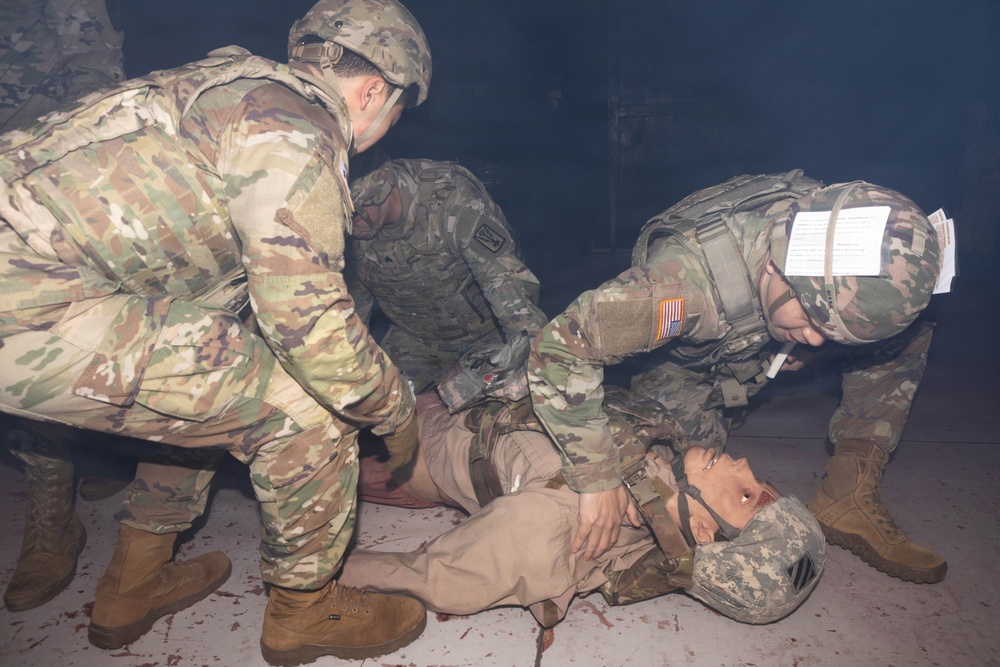
在一次模拟作战场景中,来自朝鲜半岛各地的部队牧师团队(UMT)在4月13日至15日举行的年度“朝鲜战区战略宗教伙伴关系训练”(SRPT)期间,验证了其作为战斗力倍增器的作用。
该培训由第八集团军牧师处主办,使美军牧师、宗教事务专家、驻韩美军附编韩军(KATUSA)及其大韩民国陆军同行接受了源自大规模作战环境的高强度模拟挑战。这是对其在冲击点提供宗教支持能力的验证,证明了获得支持的部队才是准备就绪的部队。
“战略宗教伙伴关系训练的任务是锻造具有韧性的牧师团队,随时准备在任何突发情况下支持部队,”第八集团军司令部牧师李上校表示,“训练利用高压模拟环境培养实用技能和宗教定力。一名具有宗教根基的士兵是专注且坚韧的。通过与韩国同行并肩训练,我们建立了联合任务中必不可少的信任和互操作性。”
训练场景旨在将牧师团队打造为战斗部队的道德锚点。团队被投入到医疗模拟训练中心的大量伤亡(MASCAL)模拟中。牧师与医疗队一起嵌入,在炮火下对模拟病人进行护理。他们对心理和精神创伤进行分诊,为预后不良的伤员举行临终仪式,进行祈祷,安慰伤员,并稳定面对重大损失的医疗人员的情绪。随后,团队还参加了针对宗教事务专家和牧师的专项技能竞赛。
In a simulated combat scenario, Unit Ministry Teams (UMTs) from across the Korean Peninsula validated their role as combat multipliers during the annual Korea Theater of Operations (KTO) Strategic Religious Partnership Training (SRPT), April 13-15.
Hosted by the Eighth Army Chaplain Directorate, the training subjected U.S. Army Chaplains, Religious Affairs Specialists, Korean Augmentation Troops to the United States Army (KATUSA), and their Republic of Korea (ROK) Army counterparts to high-intensity scenarios derived from a large-scale combat operational environment. This was a validation of their ability to provide religious support at the point of impact, proving that a force that is supported is a force that is ready.
"The mission of the Strategic Religious Partnership Training is to forge resilient Unit Ministry Teams across the Korea Theater of Operations, ready to support the force during any contingency," said Chaplain (Col.) Lee, Sun C, the Eighth Army Command Chaplain." This training uses high-pressure simulations to train our chaplains with the practical skills and religious fortitude they need to prepare Soldiers to persevere under pressure and win. A religiously grounded Soldier is a focused and resilient Soldier. By training side-by-side with our ROK counterparts, we build the trust and interoperability essential to our combined mission."
The training scenarios were designed to build the UMTs into the moral anchors of our fighting force. Teams were thrust into a mass casualty (MASCAL) simulation at Medical Simulation Training Center (MSTC). Chaplains were embedded with medical teams to perform casualty care under fire with simulated patients. They triaged mental and spiritual trauma alongside physical injuries, providing last rites to expectant casualties, prayers, comforting the wounded, and steadying the nerves of medics facing overwhelming loss.
From the MSTC, teams transitioned to the Best Religious Affairs Religious Specialist, KATUSA and Chaplain Competition (BRASK-C). These lanes tested their ability at the Camp Humphreys Confidence Course to provide direct religious support while maneuvering through challenging obstacles, advising commanders on the moral and ethical state of the unit, and conducting hasty memorial services—all critical skills to ensure a force could reconstitute and continue the fight.
"The role of religious personnel in wartime is to be the first to stand with and the last to leave our service members, providing religious comfort and emotional support,” said ROK Army Command Chaplain (Col.) Kim, Taek-jo. “Moving forward, we will continue to enhance our wartime religious support capabilities through sustained ROK-U.S. training and exchange, further strengthening the effectiveness of our support to service members.”
This training proves that religious support is an active component of combat power, reinforcing the shared commitment of the U.S.-ROK Alliance to fight and win, together.