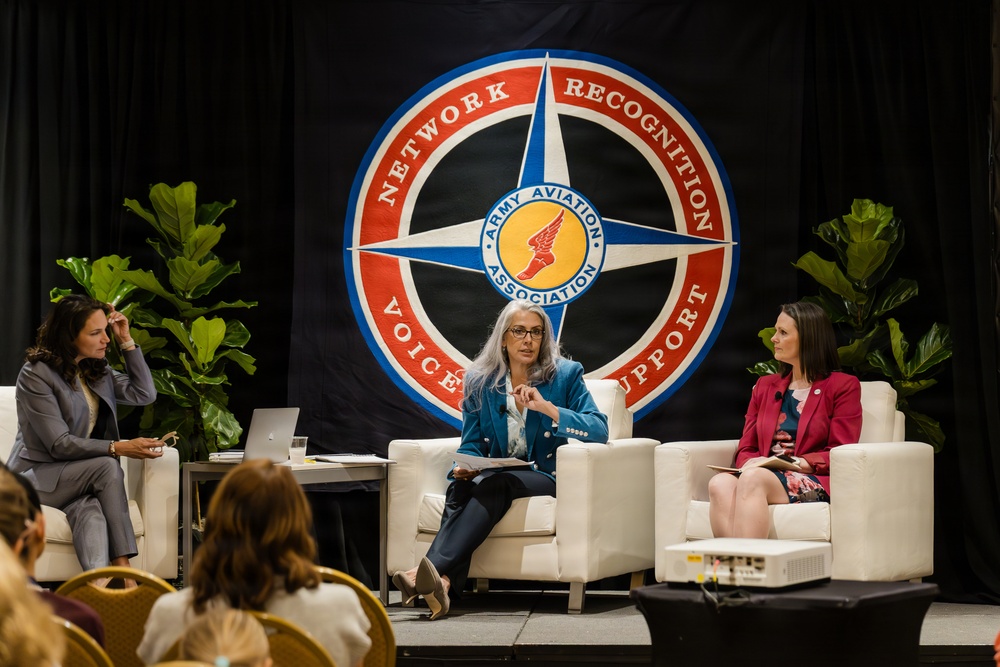
NASHVILLE, Tenn. — Army Aviation spouses shared hard-earned lessons on resilience, career continuity and raising children through constant change during a fireside chat April 16 at the annual Army Aviation Association of America Summit in Nashville, Tenn.
Moderated by Dr. Fran Gill, an emergency room physician and spouse of Maj. Gen. Clair A. Gill, commanding general of the Aviation Center of Excellence and Fort Rucker, the discussion on being “Resilient by Design” brought together Christine Obadal, a former Army intelligence officer and current Deloitte executive, and Mary Bier, CEO of the Military Child Education Coalition.
Both speakers opened with personal accounts of navigating the challenges of military family life, focusing on the difficulty of sustaining careers while managing frequent moves and deployments.
A recurring theme amongst the group was adaptability. “Adaptability, flexibility and holding the course,” Obadal said. “You don’t know how you’re going to do it until you know, and then you keep pivoting until you find what works for you. For your family.”
Bier mentioned the importance of identifying career “non-negotiables,” such as remote work, to maintain continuity.
“I knew I didn’t want to rebuild my career every time we moved,” she said. “So this was something I simply wouldn’t budge on.”
Both cautioned against the notion that military spouses can “do it all,” encouraging honesty about trade-offs instead.
“The only wrong decision is one you can’t live with,” Obadal said.
Child care was another central issue, particularly given the lack of extended family support due to frequent relocations.
“We have juggled different options over the years, from childcare to a nanny, depending on what fit for us in each season,” Gill said. “As a family with both an ER doctor and Army aviator, our childcare needs were unique, but we always found what worked for us”
Financial planning also emerged as an important factor in having two working parents. Obadal and Bier said their families often planned around a single income, treating a second income as supplemental.
“Your employment just isn’t guaranteed as a military spouse, knowing you may have to move and adapt,” Bier said. “Building a lifestyle assuming two incomes can be really risky in the beginning.”
They also highlighted career flexibility including remote work, contract roles and portable fields such as technology, project management and sales as great options to long-term success. Networking, especially with other military spouses, was strongly encouraged.
They addressed the impact of military life on children, noting that frequent moves often six to nine before high school graduation, can affect academics, mental health and social stability.
“The biggest challenge for all of us, and our kids too, is starting over again and again,” Bier said.
She added that about 70% of military-connected children attend civilian schools, where support systems can vary, making programs such as Purple Star
BROWSER2026年4月17日
陆军航空兵家属在AAAA年度峰会探讨职业韧性与家庭挑战
DVIDS美国国防部官方视觉信息发布平台