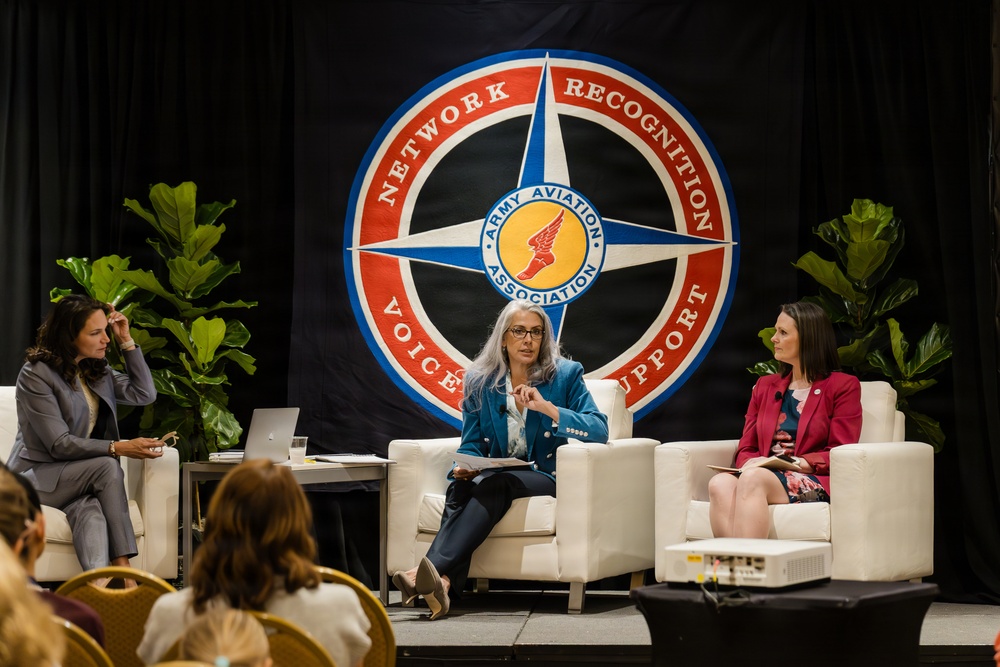
田纳西州纳什维尔 —— 4月16日,在田纳西州纳什维尔举行的美国陆军航空协会(AAAA)年度峰会上,陆军航空兵配偶在一场炉边谈话中分享了关于韧性、职业连续性以及在不断变化的环境中抚养孩子的宝贵经验。
此次讨论的主题为“设计韧性”,由急诊室医生、航空卓越中心及麦考伊堡指挥官克莱尔·吉尔少将的配偶弗兰·吉尔博士主持。讨论会邀请了前陆军情报官、现任德勤高管克里斯蒂娜·奥巴达尔,以及军事儿童教育联盟首席执行官玛丽·比尔。
两位发言者首先分享了应对军事家庭生活挑战的个人经历,重点是在应对频繁搬迁和部署的同时维持职业发展的困难。
小组讨论中一个反复出现的主题是适应性。奥巴达尔说:“适应性、灵活性并坚持航向。在你找到方法之前,你不知道自己会怎么做,然后你会不断调整,直到找到适合你和你家人的方式。”
比尔提到了确定职业“底线”的重要性,例如远程工作,以保持职业的连续性。她说:“我知道我不想在每次搬迁时都重启我的职业生涯,所以这是我绝不会退让的一点。”
两人都提醒不要抱有军事配偶可以“兼顾一切”的想法,而是鼓励对职业取舍保持诚实。奥巴达尔表示:“唯一的错误决定是你无法忍受的决定。”
育儿是另一个核心议题,特别是考虑到频繁搬迁导致缺乏大家庭的支持。吉尔表示:“这些年来,我们尝试过不同的选择,从托儿所到保姆,取决于每个阶段的情况。作为一个拥有急诊医生和陆军飞行员的家庭,我们的育儿需求很独特,但我们总能找到适合我们的方式。”
财务规划也被认为是双职父母家庭的重要因素。
NASHVILLE, Tenn. — Army Aviation spouses shared hard-earned lessons on resilience, career continuity and raising children through constant change during a fireside chat April 16 at the annual Army Aviation Association of America Summit in Nashville, Tenn.
Moderated by Dr. Fran Gill, an emergency room physician and spouse of Maj. Gen. Clair A. Gill, commanding general of the Aviation Center of Excellence and Fort Rucker, the discussion on being “Resilient by Design” brought together Christine Obadal, a former Army intelligence officer and current Deloitte executive, and Mary Bier, CEO of the Military Child Education Coalition.
Both speakers opened with personal accounts of navigating the challenges of military family life, focusing on the difficulty of sustaining careers while managing frequent moves and deployments.
A recurring theme amongst the group was adaptability. “Adaptability, flexibility and holding the course,” Obadal said. “You don’t know how you’re going to do it until you know, and then you keep pivoting until you find what works for you. For your family.”
Bier mentioned the importance of identifying career “non-negotiables,” such as remote work, to maintain continuity.
“I knew I didn’t want to rebuild my career every time we moved,” she said. “So this was something I simply wouldn’t budge on.”
Both cautioned against the notion that military spouses can “do it all,” encouraging honesty about trade-offs instead.
“The only wrong decision is one you can’t live with,” Obadal said.
Child care was another central issue, particularly given the lack of extended family support due to frequent relocations.
“We have juggled different options over the years, from childcare to a nanny, depending on what fit for us in each season,” Gill said. “As a family with both an ER doctor and Army aviator, our childcare needs were unique, but we always found what worked for us”
Financial planning also emerged as an important factor in having two working parents. Obadal and Bier said their families often planned around a single income, treating a second income as supplemental.
“Your employment just isn’t guaranteed as a military spouse, knowing you may have to move and adapt,” Bier said. “Building a lifestyle assuming two incomes can be really risky in the beginning.”
They also highlighted career flexibility including remote work, contract roles and portable fields such as technology, project management and sales as great options to long-term success. Networking, especially with other military spouses, was strongly encouraged.
They addressed the impact of military life on children, noting that frequent moves often six to nine before high school graduation, can affect academics, mental health and social stability.
“The biggest challenge for all of us, and our kids too, is starting over again and again,” Bier said.
She added that about 70% of military-connected children attend civilian schools, where support systems can vary, making programs such as Purple Star