Editor’s Note: Masha Kotkin is a geopolitical and energy analyst specializing in economics, commercial diplomacy, and energy in the Middle East and North Africa. Her work focuses on economic and energy policy, competitiveness, trade, and geopolitical risk in the Middle East. Kotkin spent over a decade at the U.S. Department of State, most recently serving as an energy advisor focused on the Middle East and North Africa. A graduate in International Economics from Johns Hopkins School of International Studies (SAIS), she has published in think tanks, including the Middle East Council on Global Affairs, Observer Research Foundation Middle Easy, and the Arab Gulf States Institute.By Barbara Slavin, Distinguished Fellow, Middle East Perspectives Project
The United Arab Emirates, Saudi Arabia, Qatar, and other Gulf countries view investment in artificial intelligence (AI) and IT services as a path to creating a highly skilled workforce and diversifying from oil and gas extraction.
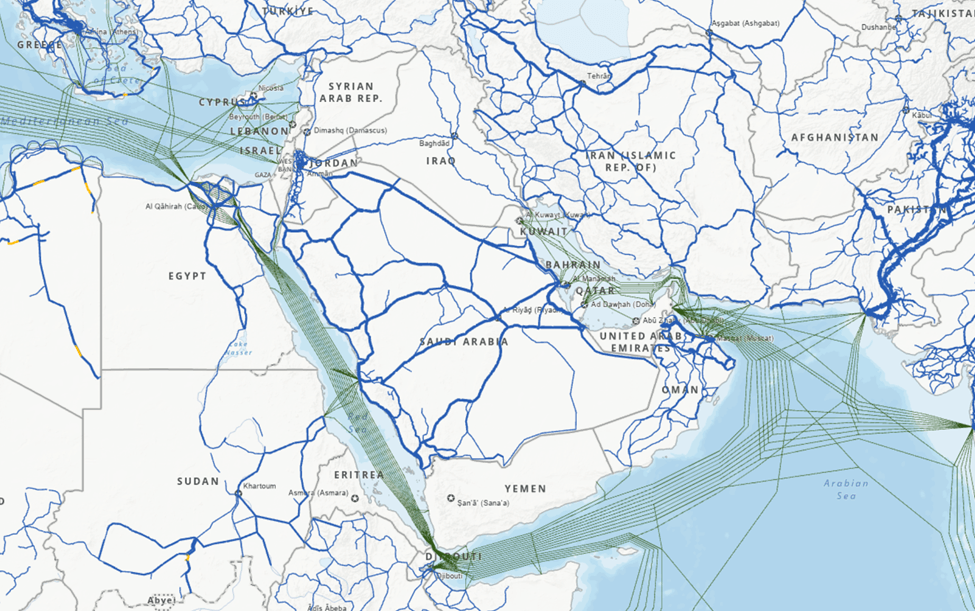
Before the outbreak of the U.S. and Israeli war on Iran, these states were attracting investment from and business partnerships with a variety of U.S. tech firms, providing responsive digital services and nurturing national tech champions such as Humain, G42, and QAI. However, profitably scaling these investments requires physical security for infrastructure and a means of delivering AI and other digital services to customers outside the region via undersea fiber optic cables.
The conflict with Iran has exposed tech infrastructure to new acute threats, with Iranian drones striking data centers in Bahrain and the UAE, Iran threatening to sever undersea cables and mine the Strait of Hormuz in response to potential troop landings, and other retaliation against U.S. tech firms operating in the Middle East in response to the assassinations of Iranian officials.
War risks have already halted work on new undersea cables in the Persian Gulf, mirroring the situation in the Red Sea where the prospect of Houthi attacks has delayed all undersea cable construction since 2024. In March 2024, a Houthi missile strike on a commercial ship in the Red Sea resulted in a damaged ship that dragged its anchor and inadvertently severed three subsea cables. After months of delays, likely due to the need to navigate geopolitical risks and sensitivities onshore in Yemen, UAE-based E-marine eventually fixed the cables. According to the industry-run International Cable Protection Committee (ICPC), out of around 200 instances of cable damage each year, only about one percent was intentional. The ICPC attributed nearly three-quarters of cable cuts to fishing equipment and ship anchors. But the same equipment that causes accidents could also be used to inflict deliberate damage by diminished-but-determined Houthi or Islamic Revolutionary Guard Corps naval forces.
Gulf Investment and Hydrocarbon Diversification
Cables create the physical path for Gulf data centers and internet users to communicate beyond the
BROWSER2026年4月17日
伊朗或打击海湾海底电缆与数据中心,地区数字基建威胁升级
史汀生中心全球安全与国际政策顶尖智库