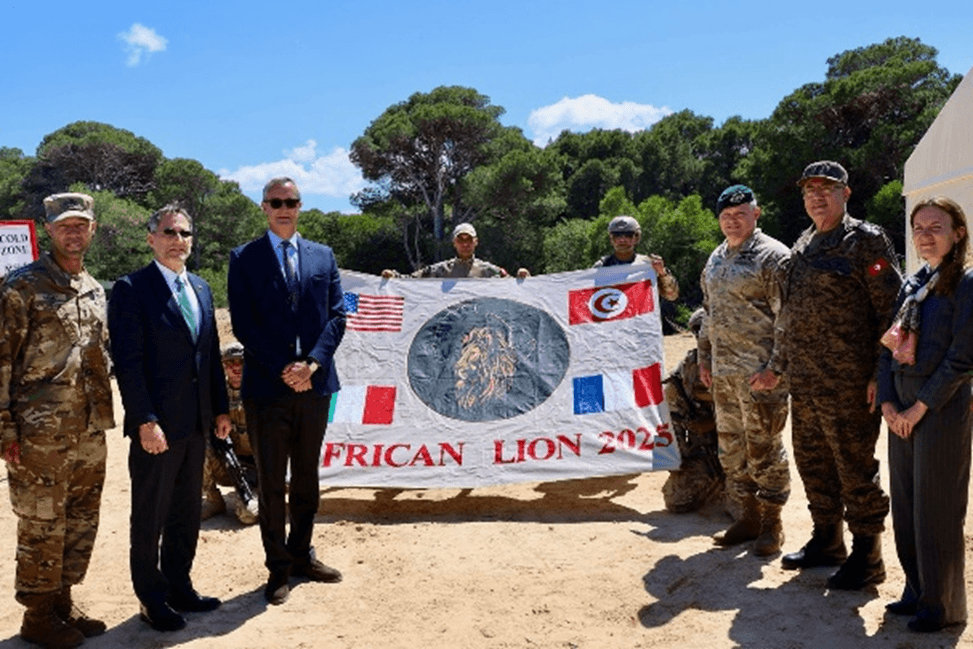
Editor’s Note: Joey R. Hood is an American diplomat and career member of the Senior Foreign Service who most recently served as U.S. Ambassador to Tunisia (2023–2025). Over a distinguished diplomatic career, he has held senior leadership roles across the Middle East, including Chargé d’affaires and Deputy Chief of Mission in Baghdad, Deputy Chief of Mission in Kuwait, and Principal Officer at the U.S. Consulate General in Dhahran, Saudi Arabia. In Washington, Hood served as Acting Assistant Secretary and Principal Deputy Assistant Secretary in the Bureau of Near Eastern Affairs, where he oversaw U.S. policy across the region. His earlier assignments include roles focused on Iran, public diplomacy in Qatar, and political-economic affairs in Yemen.A former Fulbright scholar in Burkina Faso and a Pickering Fellow, Hood holds a BA from Dartmouth College and an MA from The Fletcher School at Tufts University. He speaks French and Arabic.By Hafed Al-Ghwell, Senior Fellow and Director, North Africa Program
Introduction
In the context of the Iran war, it may seem like an odd time to be thinking about Tunisia, but our experience with the Iranian regime and Sunni extremist organizations over the past several decades teaches us that our adversaries will contest anywhere they can, and nowhere more so than in countries with highly educated populations near geographic chokepoints. With that in mind, it is no surprise that Hitler instructed Rommel to hold Tunisia as the linchpin of his Africa campaign, that Roosevelt decided Tunisia was where the U.S. Army would first face the Nazis, and that ISIS recruited so heavily there that Tunisians became, on a per capita basis, the most well-represented nationality in the “caliphate” beyond Iraq and Syria.
These are, of course, only two of the most recent examples of empires on the move trying to use Tunisia as an African beachhead. Cato the Elder’s phrase “Carthago delenda est” echoes down through the ages to us because it became symbolic of a powerful entity obsessed with destroying its rival. Over 1,400 years later, St. Louis IX, King of France, died in present-day Tunisia while pursuing his own obsession: driving a definitive wedge between the Abbasid Empire in the east and Andalusia in the west. France returned six centuries later, but not until after the Ottomans had ruled Tunisia for three centuries themselves. During that time, a new, mercantilist country arose 5,600 miles to the west, whose diplomats (two of whom would later serve as president) set their sights on negotiating treaties with Tunis and its neighbors. When those negotiations failed, this new country, the United States of America, embarked on its first foreign war to secure the Strait of Sicily for American shipping.
What is it about this small, keystone-shaped land at Africa’s northernmost point that has obsessed great powers east and west for more than two millennia? One unchanging attribute is its geographic position, occupying one side of th
BROWSER2026年4月17日
突尼斯在美中东及非洲战略中的关键地位亟待重新评估
史汀生中心全球安全与国际政策顶尖智库