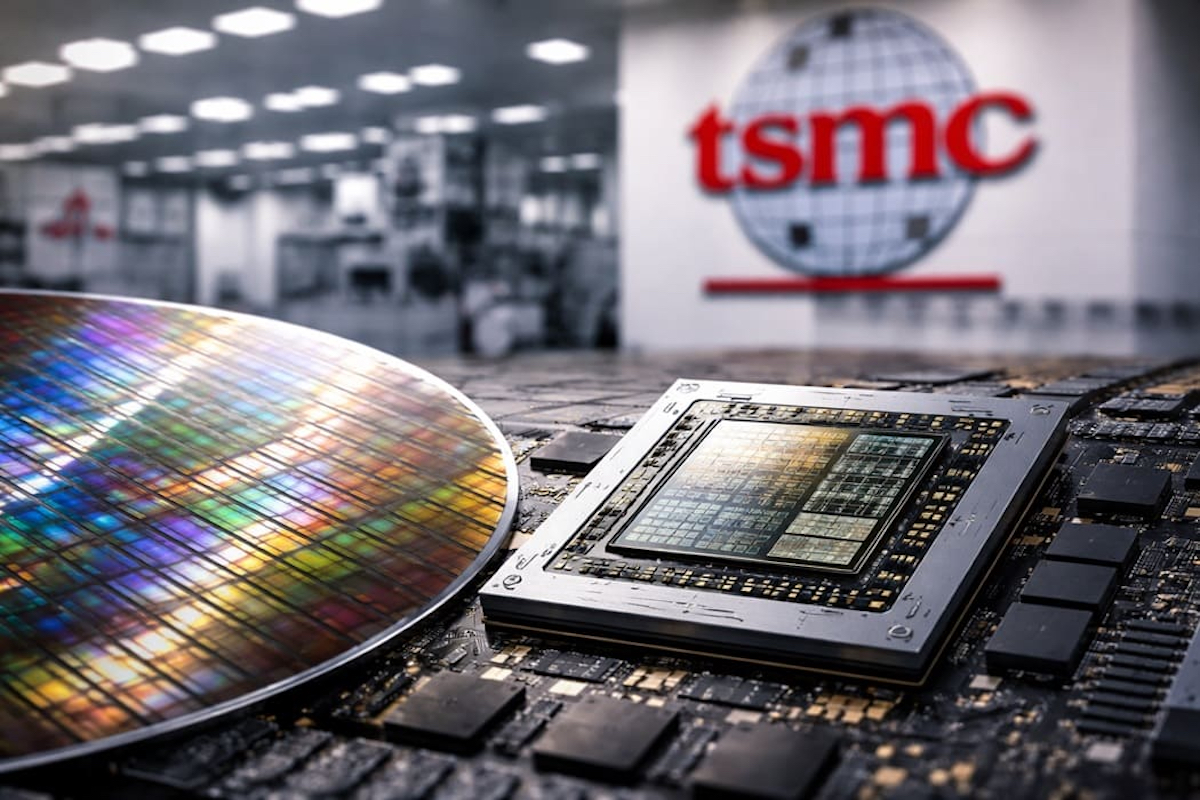
A 58% jump in TSMC’s quarterly profit, announced on April 16, should change how investors think about the AI economy. Those numbers are not speculative, based on projections or optimistic. They’re realized profits, delivered here and now.
A fourth consecutive quarter of record revenue reinforces the point. Advanced chips accounting for roughly 75% of wafer revenue make it even clearer.
I see this as a signal that the global conversation around AI is still missing where a lot of the real money is being made.
Most of the attention remains fixed on the companies building AI models and applications. That narrative is dominated by the US, specifically Silicon Valley, where breakthroughs are announced and valuations are built around future potential.
Capital has, until now at least, followed that story. But the earnings are telling a different tale altogether. The actual monetization of AI is happening deeper in the stack, at the level of advanced semiconductor production.
This is where demand is already translating into real revenue and profit at scale. TSMC’s results are the clearest evidence of this.
A 58% rise in profit doesn’t happen without sustained pricing power and structural demand. The fact that advanced chips now dominate the company’s revenue mix shows exactly where that demand is concentrated.
These are not commoditized products; they’re the foundation on which the entire AI ecosystem depends. Every major AI company relies on access to these chips. Without them, there is no scaling of models, no expansion of data centers, no acceleration of deployment.
As such, the dependency is absolute. Yet markets continue to focus on the most visible layer of the story. That, in turn, creates a misreading of where value, at least so far, is actually being captured.
The companies building AI applications are important, but they’re also dependent. The producers of advanced chips sit in a different position. They are the enablers of the AI ecosystem and, therefore, increasingly the global economy.
That distinction carries weight. Production of advanced semiconductors is highly concentrated, both in terms of companies and geography.
Taiwan sits at the center of this system, supported by a wider Asian ecosystem that has developed deep expertise in precision manufacturing, materials and engineering.
This is not a position that could be replicated quickly. Efforts to expand semiconductor manufacturing capacity outside Asia are underway, but timelines are long and execution is complex, if not fraught.
Building leading-edge fabrication capability takes years, significant capital and a level of technical refinement that cannot be rushed and is not easily replicated. In the meantime, demand for high-end chips is surging.
Every increase in AI investment feeds directly into the same supply chain. More computing power requires more advanced chips. More advanced chips require the same specialized production capacity. The cycle reinforces itself.
The dynamic strength
DIRECT2026年4月17日
台积电利润激增折射亚太人工智能防御产业链优势
Asia Times亚洲评论媒体,涉华与地区战略分析密集