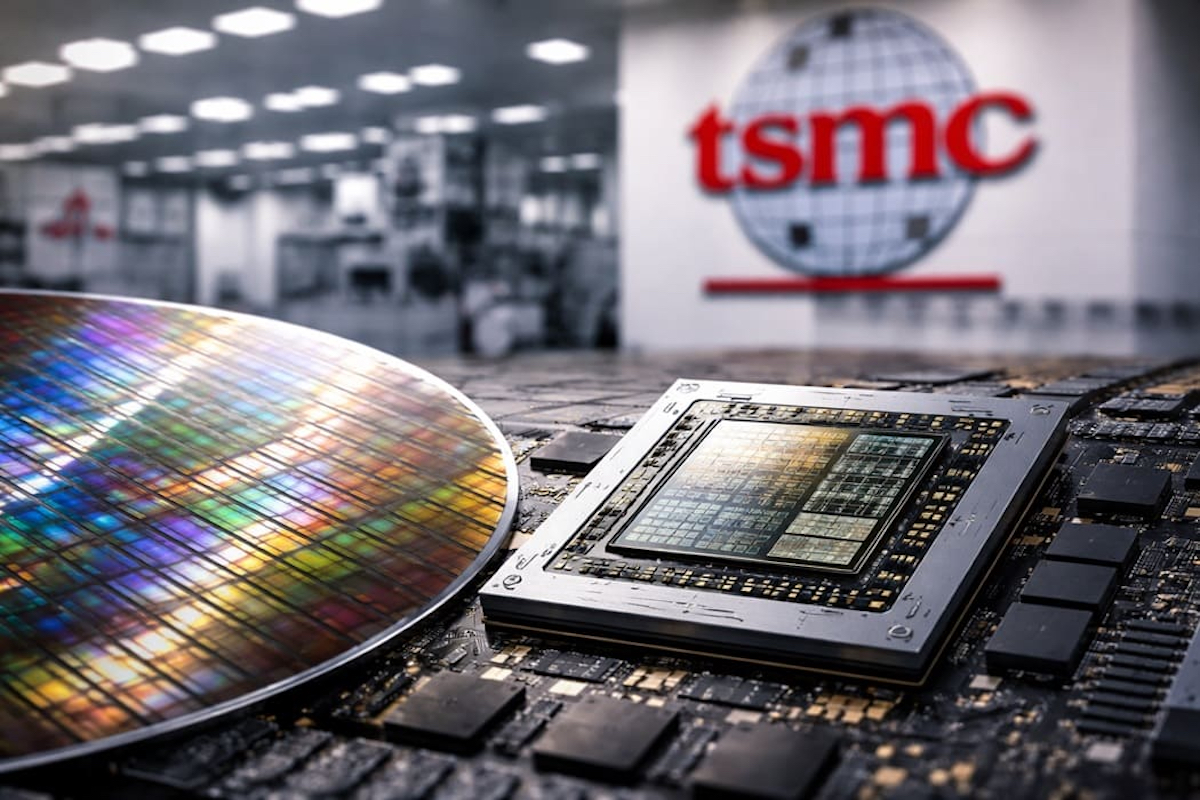
台积电(TSMC)在4月16日公布的季度利润增长58%,这应该会改变投资者对AI经济的看法。这些数据并非基于预测或乐观估计的推测,而是此时此刻已经实现的利润。
连续四个季度的创纪录营收进一步印证了这一点。其中,先进芯片占晶圆营收约75%,这让事实变得更加清晰。
我认为这是一个信号,表明全球关于AI的讨论仍然忽略了大部分真金白银的产出地。
大部分注意力仍集中在构建AI模型和应用的公司身上。这一叙事由美国(特别是硅谷)主导,那里发布突破性成果,估值也围绕未来潜力构建。
至少到目前为止,资本一直追随这个故事。但财报却讲述了一个完全不同的故事。AI真正的货币化正发生在产业链更深层,即先进半导体制造层面。
在这里,需求已经转化为大规模的实际营收和利润。台积电的业绩就是最明确的证据。
如果没有持续的定价权和结构性需求,利润不可能增长58%。先进芯片目前在公司营收结构中占据主导地位,这一事实恰恰说明了需求集中的位置。
这些不是商品化的产品,它们是整个AI生态系统赖以生存的基石。每一家主要的AI公司都依赖这些芯片。没有它们,就没有模型的扩展,没有数据中心的扩张,也没有部署的加速。
因此,这种依赖是绝对的。然而市场继续关注故事中最显眼的层面。反过来,这导致了对价值捕获地(至少到目前为止)的误读。
构建AI应用的公司固然重要,但它们也是具有依赖性的。先进芯片制造商处于不同的地位。它们是AI生态系统的推动者,因此也日益
A 58% jump in TSMC’s quarterly profit, announced on April 16, should change how investors think about the AI economy. Those numbers are not speculative, based on projections or optimistic. They’re realized profits, delivered here and now.
A fourth consecutive quarter of record revenue reinforces the point. Advanced chips accounting for roughly 75% of wafer revenue make it even clearer.
I see this as a signal that the global conversation around AI is still missing where a lot of the real money is being made.
Most of the attention remains fixed on the companies building AI models and applications. That narrative is dominated by the US, specifically Silicon Valley, where breakthroughs are announced and valuations are built around future potential.
Capital has, until now at least, followed that story. But the earnings are telling a different tale altogether. The actual monetization of AI is happening deeper in the stack, at the level of advanced semiconductor production.
This is where demand is already translating into real revenue and profit at scale. TSMC’s results are the clearest evidence of this.
A 58% rise in profit doesn’t happen without sustained pricing power and structural demand. The fact that advanced chips now dominate the company’s revenue mix shows exactly where that demand is concentrated.
These are not commoditized products; they’re the foundation on which the entire AI ecosystem depends. Every major AI company relies on access to these chips. Without them, there is no scaling of models, no expansion of data centers, no acceleration of deployment.
As such, the dependency is absolute. Yet markets continue to focus on the most visible layer of the story. That, in turn, creates a misreading of where value, at least so far, is actually being captured.
The companies building AI applications are important, but they’re also dependent. The producers of advanced chips sit in a different position. They are the enablers of the AI ecosystem and, therefore, increasingly the global economy.
That distinction carries weight. Production of advanced semiconductors is highly concentrated, both in terms of companies and geography.
Taiwan sits at the center of this system, supported by a wider Asian ecosystem that has developed deep expertise in precision manufacturing, materials and engineering.
This is not a position that could be replicated quickly. Efforts to expand semiconductor manufacturing capacity outside Asia are underway, but timelines are long and execution is complex, if not fraught.
Building leading-edge fabrication capability takes years, significant capital and a level of technical refinement that cannot be rushed and is not easily replicated. In the meantime, demand for high-end chips is surging.
Every increase in AI investment feeds directly into the same supply chain. More computing power requires more advanced chips. More advanced chips require the same specialized production capacity. The cycle reinforces itself.
The dynamic strength