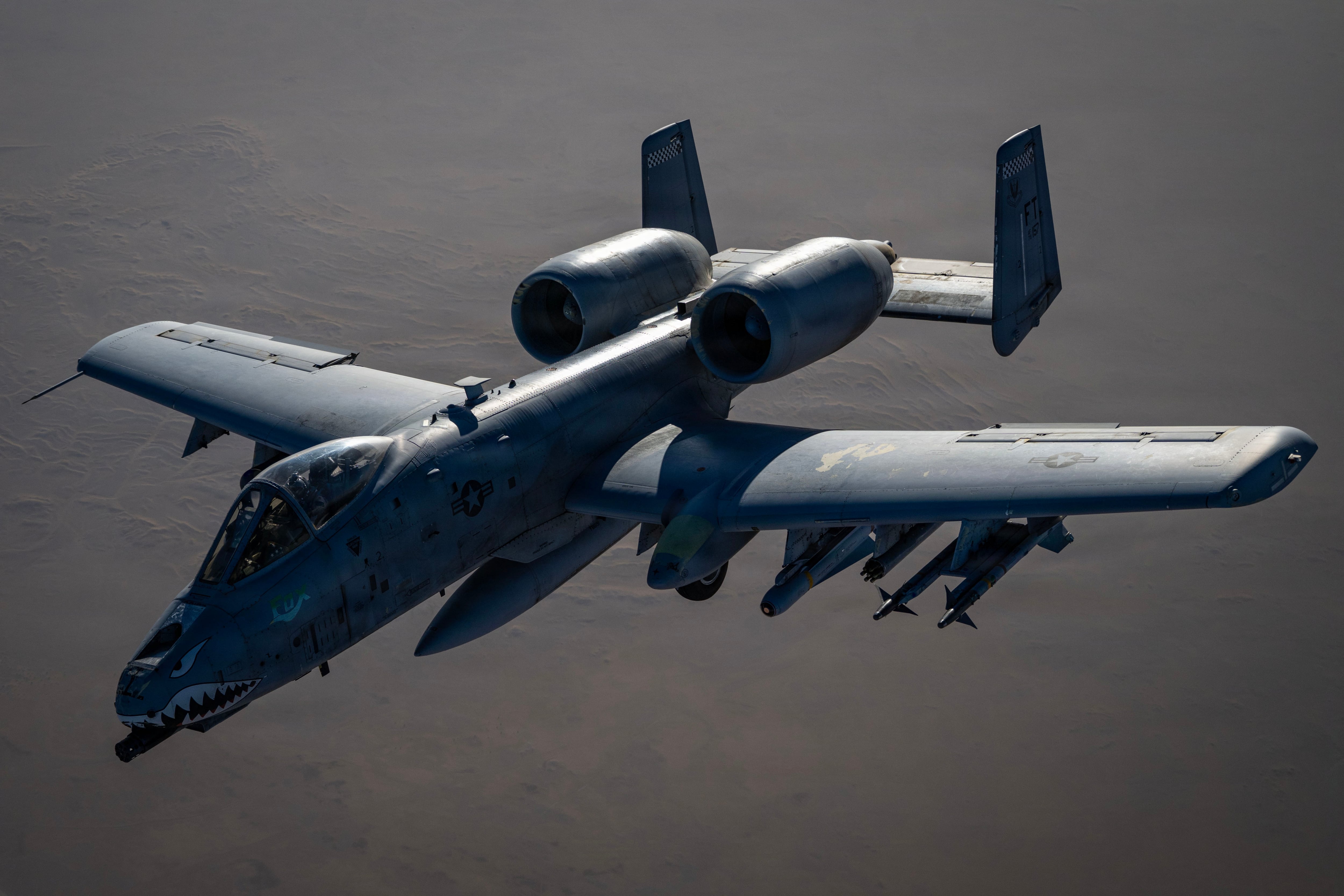
The callsign “Sandy,” used by U.S. Air Force aircraft and pilots conducting combat search-and-rescue operations, traces to late 1965. Capt. J.W. “Doc” George, a U.S. Air Force A-1 Skyraider pilot, arrived at Udorn Royal Thai Air Force Base, Thailand, as part of a CSAR replacement rotation from Bien Hoa, South Vietnam. When asked what callsign his flight would use, he suggested the one he used at Bien Hoa: “Sandy.” The name stuck, was passed to his replacement and soon became the standard callsign for all A-1 Skyraiders flying CSAR missions protecting downed aircrews.The Sandy role was later transferred to the faster LTV A-7D Corsair II in 1972 as the last Skyraiders were withdrawn from Southeast Asia. However, the A-7 struggled in the role due to its higher maneuvering speeds, which made it less effective for low-and-slow visual searches and close helicopter escort than the A-1.In the late 1970s, the Corsair passed the CSAR baton to the A-10 Thunderbolt II Warthog, which offered excellent loiter time, survivability and firepower suited to the mission. The A-10 airframe and its pilots still carry the “Sandy” callsign today.As the Air Force accelerates plans to retire the A-10 Thunderbolt II by fiscal year 2029, the service faces a growing set of unanswered questions about what replaces it in combat search and rescue, one of the military’s most specialized mission sets. More than an analysis of replacement aircraft and their capabilities, the transition raises concerns about the pilots in the cockpit, who for nearly five decades have received specialized training in the combat search-and -rescue mission and built trust within the CSAR community. With congressional oversight and legislation underscoring concerns about CSAR operational readiness, and on the heels of a CSAR mission over Iran that brought two F-15E airmen home, the stakes of those unanswered questions have taken on a new sense of urgency.Highly skilled Sandy pilotsIn the past several decades, A-10s have assumed the Sandy role in CSAR operations in the Gulf War, Iraq, Afghanistan, Kosovo and most recently in the April 3, 2026, operation that recovered two American F-15E Strike Eagle airmen from Iranian territory. One supporting A-10 sustained heavy battle damage during the mission; its pilot continued flying long enough to eject safely over Kuwait.During an April 6, 2026, press conference detailing that mission, Gen. Dan Caine, chairman of the Joint Chiefs of Staff, described the role of a Sandy: “A Sandy has one mission: to get to the survivor, bring the rescue force forward, and put themselves between that survivor on the ground and the enemy,” Caine said. “They are committed to this. This is what they live for. And this is what they’ve trained for, for many, many years.”RELATEDThe rescue mission that brought 2 F-15E Strike Eagle crew members homeOnly the most experienced A-10 pilots are selected for Sandy qualification, which requires specialized training in CSAR tactics and procedur
DIRECT2026年4月17日
美空军A-10退役或影响亚太高强度战场搜救能力
防务新闻美国军工采办媒体,装备和预算追踪稳定