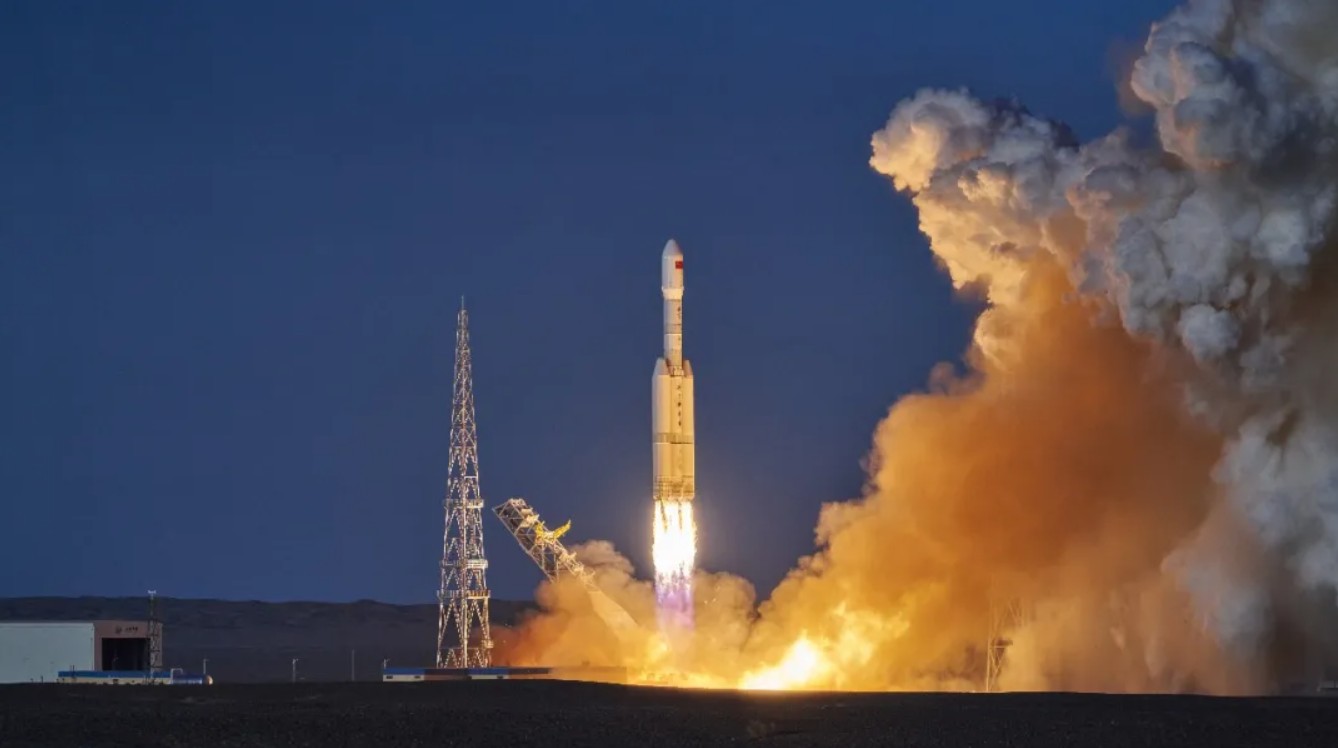
The first Kinetica-2 rocket rises into the sky at Jiuquan's commercial launch zone, March 30, 2026. Credit: CAS Space
HELSINKI — China has conducted rendezvous and proximity operations tests involving a prototype cargo spacecraft and a satellite in a step towards low-cost orbital infrastructure.
The Qingzhou prototype spacecraft launched on CAS Space’s first Kinetica-2 kerosene-liquid oxygen rocket March 30, successfully entering orbit, carrying two small companion satellites.
The Qingzhou prototype spacecraft, developed by the Innovation Academy for Microsatellites of the Chinese Academy of Sciences (IAMCAS), raised itself to a 622 by 584-kilometer orbit, as part of planned on-orbit testing related to its design as a cargo spacecraft to resupply the Tiangong space station. It then released the two satellites into orbit.
An update from the Aerospace Information Research Institute of the Chinese Academy of Sciences (AIRCAS) April 16 reveals that its small New Journey-01 satellite completed a long-distance rendezvous approach and safe withdrawal test with the 4,200-kilogram Qingzhou experimental spacecraft.
Described as a “space lighthouse,” by the AIRCAS statement, the New Journey-01 satellite likely acted as a cooperative navigation target, providing reference signals or tracking features to support approach and departure phases.
An image showing the spacecraft separated by around 5 kilometers indicates testing of mid-range rendezvous and proximity operations (RPO). This suggests the demonstration of precision approach capabilities, including relative navigation, guidance, navigation and control (GNC), and potentially autonomous decision-making, without attempting close-range proximity or docking.
RPO capabilities are considered dual-use, used for both civilian applications such as servicing and debris removal and potential on-orbit inspection or counterspace activities.
The Qingzhou prototype is one of two low-cost space station resupply spacecraft being developed under a program initiated by China’s human spaceflight agency, CMSEO, to support Tiangong.
The spacecraft carries 27 experimental payloads totaling 1,020 kg and has a design lifetime of up to three years in orbit. Global Times, citing IAMCAS, reported that the spacecraft had completed a series of initial objectives, laying the foundation for the formal development of the Qingzhou cargo spacecraft. The full Qingzhou will fly cargo to Tiangong. The other spacecraft being developed under the program, named Haolong, is a 10-meter-long, 7,000 kg reusable mini-shuttle design.
The tests have relevance beyond China’s low-cost cargo plans, which complement the existing Tianzhou freighter, pointing toward broader ambitions in autonomous and scalable in-orbit operations.
AIRCAS stated the on-orbit tests marked progress for its plans. New Journey-01 completed a series of missions, including in-space robotic operations, spatial display and interactive interface experiments, Earth limb observation a
DIRECT2026年4月17日
中国“轻舟”货运航天器原型完成轨道交会对接测试
SpaceNews航天与太空安全专业媒体,涉华太空军情常见