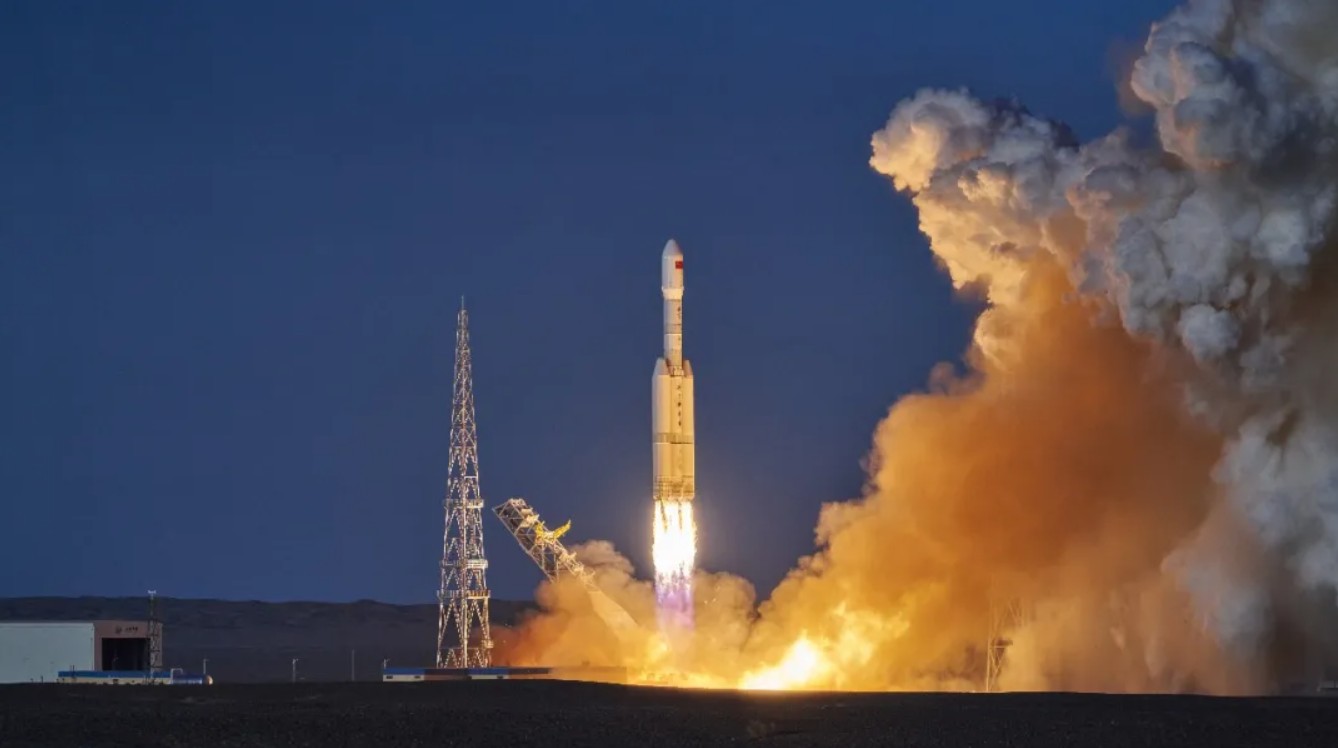
2026 年 3 月 30 日,首枚“力箭二号”(Kinetica-2)火箭在酒泉商业航天发射场升空。来源:中科宇航(CAS Space)
赫尔辛基——中国利用货运飞船原型和一颗卫星进行了交会与近距离操作(RPO)测试,这是迈向低成本轨道基础设施的一步。
3 月 30 日,“轻舟”号原型飞船搭乘中科宇航的首枚“力箭二号”煤油液氧火箭发射升空,成功进入轨道,并携带了两颗小型伴随卫星。
由中国科学院微小卫星创新研究院(IAMCAS)研制的“轻舟”号原型飞船将轨道提升至 622 x 584 公里,作为与其货运飞船设计相关的计划内轨道测试的一部分,该飞船旨在为天宫空间站提供补给。随后,它将两颗卫星释放入轨。
中国科学院空天信息创新研究院(AIRCAS)4 月 16 日发布的更新消息显示,其研制的小型“新征程一号”卫星与 4,200 公斤级的“轻舟”号实验飞船完成了远距离交会接近和安全撤离测试。
在 AIRCAS 的声明中,“新征程一号”卫星被描述为“空间灯塔”,它可能充当了协作导航目标,提供参考信号或跟踪特征,以支持接近和离开阶段。
一张显示航天器间隔约 5 公里的图片表明,双方正在进行中程交会与近距离操作(RPO)测试。这表明已验证了精密接近能力,包括相对导航、制导、导航与控制(GNC)以及潜在的自主决策,且未尝试近距离接触或对接。
RPO 能力被认为是军民两用技术,既可用于在轨服务和碎片清理等民用用途,也可用于潜在的在轨检查或反空间活动。
“轻舟”号原型是正在研制的两种低成本空间站补给航天器之一……
The first Kinetica-2 rocket rises into the sky at Jiuquan's commercial launch zone, March 30, 2026. Credit: CAS Space
HELSINKI — China has conducted rendezvous and proximity operations tests involving a prototype cargo spacecraft and a satellite in a step towards low-cost orbital infrastructure.
The Qingzhou prototype spacecraft launched on CAS Space’s first Kinetica-2 kerosene-liquid oxygen rocket March 30, successfully entering orbit, carrying two small companion satellites.
The Qingzhou prototype spacecraft, developed by the Innovation Academy for Microsatellites of the Chinese Academy of Sciences (IAMCAS), raised itself to a 622 by 584-kilometer orbit, as part of planned on-orbit testing related to its design as a cargo spacecraft to resupply the Tiangong space station. It then released the two satellites into orbit.
An update from the Aerospace Information Research Institute of the Chinese Academy of Sciences (AIRCAS) April 16 reveals that its small New Journey-01 satellite completed a long-distance rendezvous approach and safe withdrawal test with the 4,200-kilogram Qingzhou experimental spacecraft.
Described as a “space lighthouse,” by the AIRCAS statement, the New Journey-01 satellite likely acted as a cooperative navigation target, providing reference signals or tracking features to support approach and departure phases.
An image showing the spacecraft separated by around 5 kilometers indicates testing of mid-range rendezvous and proximity operations (RPO). This suggests the demonstration of precision approach capabilities, including relative navigation, guidance, navigation and control (GNC), and potentially autonomous decision-making, without attempting close-range proximity or docking.
RPO capabilities are considered dual-use, used for both civilian applications such as servicing and debris removal and potential on-orbit inspection or counterspace activities.
The Qingzhou prototype is one of two low-cost space station resupply spacecraft being developed under a program initiated by China’s human spaceflight agency, CMSEO, to support Tiangong.
The spacecraft carries 27 experimental payloads totaling 1,020 kg and has a design lifetime of up to three years in orbit. Global Times, citing IAMCAS, reported that the spacecraft had completed a series of initial objectives, laying the foundation for the formal development of the Qingzhou cargo spacecraft. The full Qingzhou will fly cargo to Tiangong. The other spacecraft being developed under the program, named Haolong, is a 10-meter-long, 7,000 kg reusable mini-shuttle design.
The tests have relevance beyond China’s low-cost cargo plans, which complement the existing Tianzhou freighter, pointing toward broader ambitions in autonomous and scalable in-orbit operations.
AIRCAS stated the on-orbit tests marked progress for its plans. New Journey-01 completed a series of missions, including in-space robotic operations, spatial display and interactive interface experiments, Earth limb observation a