The TWZ Newsletter
Weekly insights and analysis on the latest developments in military technology, strategy, and foreign policy.
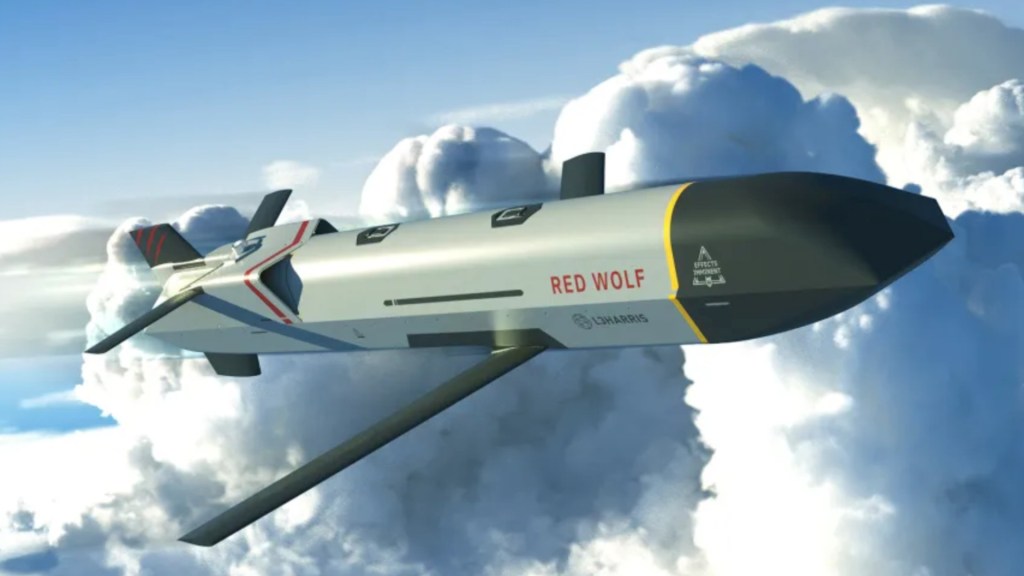
L3Harris is pushing its modular Wolf Pack family of “launched effects vehicles” for the U.S. Army, including to equip its H-60 Black Hawk series and AH-64 Apache helicopters, with an eye on the specific demands of a future conflict in the Pacific. The family of vehicles includes the Red Wolf, configured for long-range precision strikes against targets on land or at sea, and the Green Wolf fitted with an electronic warfare payload. Overall, these are part of a wider drive toward fielding modular, relatively cheap, and small systems that increasingly blur the line between uncrewed aerial systems, especially longer-range kamikaze drones, and cruise missiles, as well as decoys.
Readers can refer to our previous coverage of the Wolf Pack family, and it is also worth noting that the company is under contract with the U.S. Marine Corps to deliver the related PASM, the Precision Attack Strike Munition.
At the Army Aviation Association of America’s Army Aviation Warfighting Summit in Nashville, Tennessee, this week, TWZ caught up with Brad Reeves, the director of strategy and requirements for the Agile Development Group at L3Harris, to talk about the company’s vision for the Wolf family with the Army.
A rendering of the Red Wolf launched effects vehicle. L3Harris L3Harris
TWZ: What is the primary driver behind the Wolf family, and how is it relevant to the Army’s rotary-wing fleets?
Brad Reeves: The Department of War has a heavy emphasis on the Pacific and a conflict over there. Mass is an issue. We have a lot of exquisite weapons today, but the numbers are not maybe as high as we might hope for a conflict over there. So, they’re trying to solve that problem. Affordable mass has kind of become the buzzword, which basically means, “hey, how do we get capability that we can buy in quantity without breaking the bank?” And so, with that, the Department of War, actually Secretary Hegseth, issued a memo on April 30 of last year. And one of the things he called out specifically was launched effects, the urgency to get that fielded beginning this year. So, that’s a high-emphasis item for those guys.
A U.S. Army UH-60M Black Hawk. U.S. Air Force photo
Launched effects are really meant to be an affordable mass solution for the Army. But the real story behind this is what we call our Wolf Pack family of systems, and our offering and the capability it brings. And the story here is it’s very capable, but it’s what it does for the Army and for Army aviation. So it’s transforming Army aviation, and it’s addressing platforms that lack some relevancy today in the fight. Black Hawks, Apaches, etc, have a very short-range capability, relatively speaking, when you’re talking about the Pacific, and you have the tyranny of distance and anti-access/area-denial threats. It’s a much harder challenge than what we’ve dealt with in the decades si
DIRECT2026年4月17日
美军推进“狼群”模块化巡航导弹研发 提升陆航直升机打击能力
战区美国专业军媒,装备细节与作战动态强