BOULDER, Colorado – The sun’s volatile outbursts, such as storms, flares and other space weather, can cause serious harm to astronauts like the Artemis 2 crew who recently came home, and to satellites. That’s why the Space Weather Prediction Center (SWPC) in Boulder, Colorado — part of the National Oceanic and Atmospheric Administration — is working to sharpen space weather forecasting skills, honing the ability to monitor the space environment and provide solar-terrestrial information. The SWPC, the official source of space weather alerts and warnings for the United States, is driven to monitor solar outbursts that can impact satellite communications, GPS systems and electric power transmission here on Earth.
Gathering data about the sun’s output also played a major role during the 10-day Artemis 2 mission, where operators on the ground kept a 24/7 vigil to keep an eye on threatening solar radiation storms.
“There is a growing vulnerability from space weather to a range of technologies,” SWPC Director Clinton Wallace told SpaceNews. “Prediction is giving our best educated, informed decision based on observations and models that we have.”
To that end, understanding solar storm phenomena is a critical component to producing accurate space weather forecasts, from onset of an event to location, duration and severity, Wallace said. But space weather forecasting is decades behind terrestrial weather prediction, he added.
“We’re a lot younger. We have a long ways to go to catch up and have the same level of maturity,” said Wallace, who added that the SWPC is working to develop better models, based on physics research and artificial intelligence, that can forecast events while also reporting on uncertainty and risk.
Protecting the Artemis 2 crew
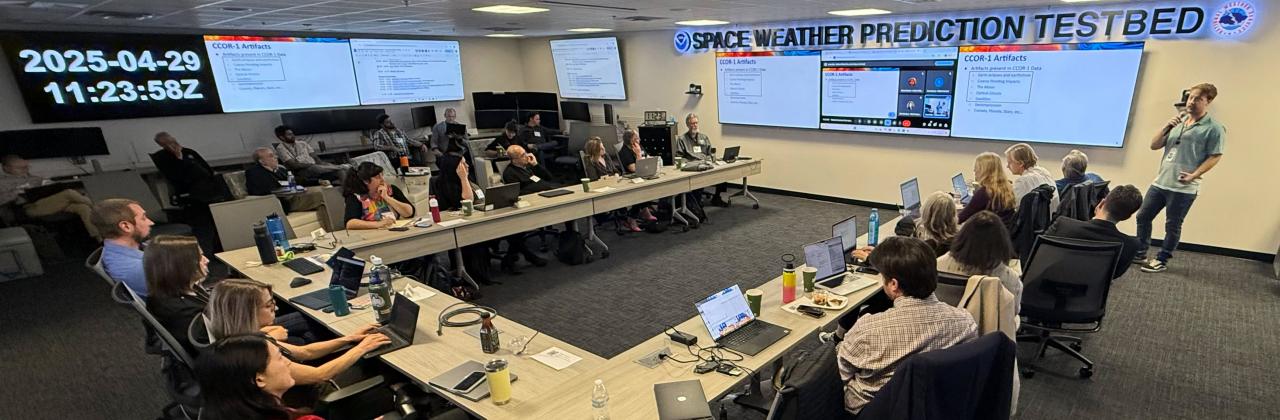
Since becoming the SWPC Director in March 2019, Wallace championed the creation of a new space weather prediction testbed. That dedicated room enables customers, researchers, and forecasters to engage collaboratively on improvements to observations, models and forecast products.
In April and May of 2025, the testbed saw more than 70 participants from NASA, the U.S. Air Force, commercial space companies, research institutions and international partners taking part in Artemis 2 exercises. Participants worked together through simulated radiation storm scenarios and assessed space weather modeling measures.
Artemis 2 testbed exercise held last year at the National Oceanic and Atmospheric Administration’s Space Weather Prediction Center in Boulder, Colorado. Credit: National Weather Service/ NOAA
Wallace said that the SWPC testbed exercises for the Artemis 2 flight “far exceeded every expectation.”
That hands-on, immersive experience sharpened space weather forecasting knowhow, said Shawn Dahl, a service coordinator at the SWPC. “It gave us the opportunity to test, evaluate and improve our models on the spot,” he said.
Dahl added that, prior to the Artemis 2 launch, SWPC had frequent decision-support conversations wi
BROWSER2026年4月17日
美智库研判太空天气预报技术对军事资产的保障价值
SpaceNews航天与太空安全专业媒体,涉华太空军情常见