科罗拉多州博尔德——太阳的剧烈爆发(如风暴、耀斑和其他空间天气)可能会对像最近返回家园的“阿耳忒弥斯2号”(Artemis 2)成员那样的宇航员以及卫星造成严重伤害。这就是为什么位于科罗拉多州博尔德的空间天气预报中心(SWPC)——美国国家海洋和大气管理局(NOAA)的一部分——正致力于提高空间天气预报技能,磨练监测空间环境并提供日地信息的能力。空间天气预报中心是美国官方发布空间天气警报和预警的机构,致力于监测可能影响地球上卫星通信、GPS系统和电力传输的太阳爆发。
收集有关太阳输出的数据在为期10天的“阿耳忒弥斯2号”任务中也发挥了重要作用,地面操作员进行24小时不间断警戒,以监视具有威胁性的太阳辐射风暴。
空间天气预报中心主任克林顿·华莱士(Clinton Wallace)告诉《航天新闻》(SpaceNews):“一系列技术受空间天气影响的脆弱性正在增加。预报是根据我们拥有的观测和模型,给出最专业的、有据可依的决策。”
华莱士说,为此,理解太阳风暴现象是产生准确空间天气预报的关键组成部分,从事件的发生到位置、持续时间和严重程度。但他补充说,空间天气预报落后于地面天气预报数十年。
“我们年轻得多。要赶上并达到同样的成熟水平,我们还有很长的路要走,”华莱士说道,他补充说空间天气预报中心正在致力于基于物理研究和人工智能开发更好的模型,在预报事件的同时也能报告不确定性和风险。
保护阿耳忒弥斯2号机组人员
自2019年3月担任空间天气预报中心主任以来,华莱士一直倡导建立一个新的空间天气预报试验台。该专用房间使客户、研究人员和预报员能够就改进[工作]进行协作。
BOULDER, Colorado – The sun’s volatile outbursts, such as storms, flares and other space weather, can cause serious harm to astronauts like the Artemis 2 crew who recently came home, and to satellites. That’s why the Space Weather Prediction Center (SWPC) in Boulder, Colorado — part of the National Oceanic and Atmospheric Administration — is working to sharpen space weather forecasting skills, honing the ability to monitor the space environment and provide solar-terrestrial information. The SWPC, the official source of space weather alerts and warnings for the United States, is driven to monitor solar outbursts that can impact satellite communications, GPS systems and electric power transmission here on Earth.
Gathering data about the sun’s output also played a major role during the 10-day Artemis 2 mission, where operators on the ground kept a 24/7 vigil to keep an eye on threatening solar radiation storms.
“There is a growing vulnerability from space weather to a range of technologies,” SWPC Director Clinton Wallace told SpaceNews. “Prediction is giving our best educated, informed decision based on observations and models that we have.”
To that end, understanding solar storm phenomena is a critical component to producing accurate space weather forecasts, from onset of an event to location, duration and severity, Wallace said. But space weather forecasting is decades behind terrestrial weather prediction, he added.
“We’re a lot younger. We have a long ways to go to catch up and have the same level of maturity,” said Wallace, who added that the SWPC is working to develop better models, based on physics research and artificial intelligence, that can forecast events while also reporting on uncertainty and risk.
Protecting the Artemis 2 crew
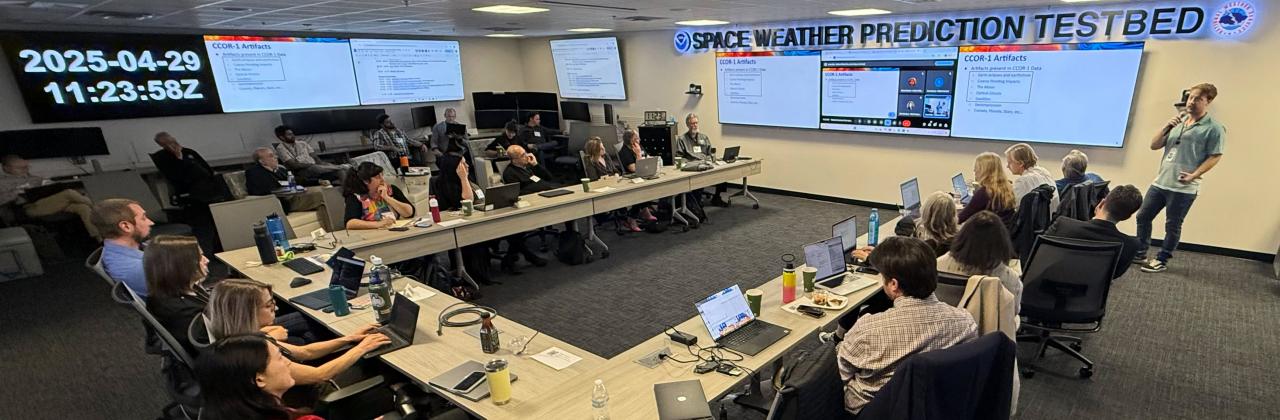
Since becoming the SWPC Director in March 2019, Wallace championed the creation of a new space weather prediction testbed. That dedicated room enables customers, researchers, and forecasters to engage collaboratively on improvements to observations, models and forecast products.
In April and May of 2025, the testbed saw more than 70 participants from NASA, the U.S. Air Force, commercial space companies, research institutions and international partners taking part in Artemis 2 exercises. Participants worked together through simulated radiation storm scenarios and assessed space weather modeling measures.
Artemis 2 testbed exercise held last year at the National Oceanic and Atmospheric Administration’s Space Weather Prediction Center in Boulder, Colorado. Credit: National Weather Service/ NOAA
Wallace said that the SWPC testbed exercises for the Artemis 2 flight “far exceeded every expectation.”
That hands-on, immersive experience sharpened space weather forecasting knowhow, said Shawn Dahl, a service coordinator at the SWPC. “It gave us the opportunity to test, evaluate and improve our models on the spot,” he said.
Dahl added that, prior to the Artemis 2 launch, SWPC had frequent decision-support conversations wi