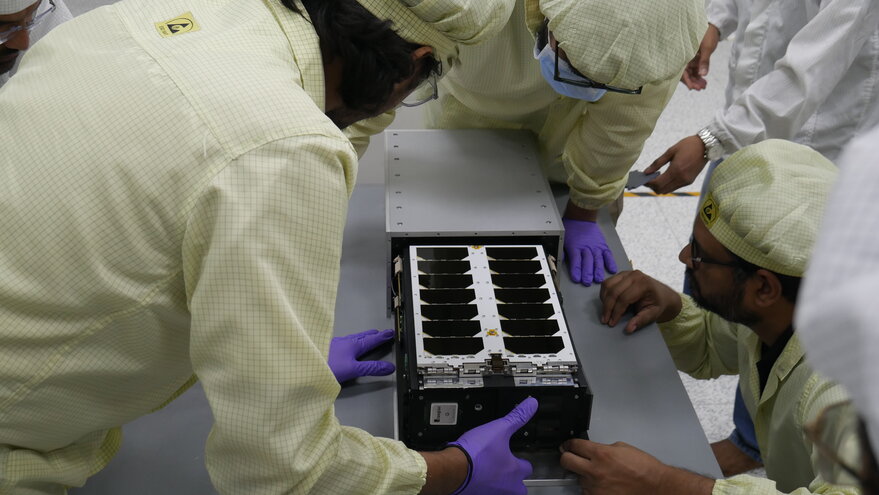
TakeMe2Space正准备利用SpaceX猎鹰9号拼箭任务发射一架6U立方体卫星。图片来源:TakeMe2Space
科罗拉多斯普林斯——在1月份宣布了500万美元的种子轮融资后,印度初创公司TakeMe2Space寻求筹集5500万美元,以建立一个50千瓦的轨道数据中心。
TakeMe2Space创始人罗纳克·库马尔·萨曼特雷(Ronak Kumar Samantray)告诉《航天新闻》:“对我们来说,关键是证明我们可以在全球范围内参与轨道数据中心的游戏。在50到100千瓦的计算规模周围有很大的流动性,因为这将成为吉瓦级轨道数据中心的基石。”
萨曼特雷在其之前的软件即服务(SaaS)初创公司NowFloats Technologies于2019年被信实工业(Reliance Industries)收购后创立了TakeMe2Space。在2024年底创立TakeMe2Space之前,萨曼特雷及其同事对一种用于保护GPU免受太阳辐射的专利材料进行了空间飞行测试。
TakeMe2Space于2024年12月利用印度的极轨卫星运载火箭(PSLV)将首颗卫星送入太空。这颗名为“我的轨道基础设施-技术演示”(My Orbital Infrastructure-Tech Demonstration)的1U立方体卫星在保持与PSLV第四级连接的同时,为其星载计算机、边缘处理器以及姿态确定与控制系统提供了飞行遗产。
萨曼特雷说:“三位客户上传了他们的人工智能模型,进行了推理并得到了结果。”
分阶段方法
10月,TakeMe2Space将利用SpaceX猎鹰9号拼箭任务发射一架配备英伟达(Nvidia)Jetson模块的6U立方体卫星。计划上传数据并为这颗对地成像立方体卫星分配任务的客户,目前正在该卫星的物理孪生体上测试人工智能模型。
下一项任务将于2027年利用近期融资轮的资金发射,届时将是由四颗卫星组成的星座,每颗卫星质量约为100公斤,通过空间激光星载链路共享数据。
萨曼特雷说:“在那里的目标是利用轨道上的5千瓦计算能力实现1500万美元的年收入。”
市场分析
在开发……
TakeMe2Space is preparing to launch a six-unit cubesat on a SpaceX Falcon 9 rideshare. Credit: TakeMe2Space
COLORADO SPRINGS – After announcing a $5 million seed round in January, Indian startup TakeMe2Space seeks to raise $55 million to establish a 50-kilowatt orbital data center.
“What is key for us is to demonstrate that we can play the orbital data center game globally,” TakeMe2Space founder Ronak Kumar Samantray told SpaceNews. “There’s a lot of liquidity around 50- to 100-kilowatt compute scale, because that’s what will become the building block for a gigawatt orbital data center.”
Samantray established TakeMe2Space after his previous software-as-a-service startup NowFloats Technologies was acquired in 2019 by Reliance Industries. Before founding TakeMe2Space in late 2024, Samantray and colleagues performed spaceflight testing on a proprietary material to protect GPUs from solar radiation.
TakeMe2Space sent its first satellite aloft in December 2024 on India’s Polar Satellite Launch Vehicle (PSLV). The one-unit cubesat, called My Orbital Infrastructure-Tech Demonstration, provided flight heritage for the startup’s onboard computer, edge processor and attitude determination and control system, while remaining attached to PSLV’s fourth stage.
“Three customers uploaded their AI model, did inferencing and got the results,” Samantray said.
Tiered Approach
In October, TakeMe2Space will launch a six-unit cubesat equipped with an Nvidia Jetson module on a SpaceX Falcon 9 rideshare. Customers who plan to upload data and task the Earth-imaging cubesat are testing AI models on the satellite’s physical twin.
The following mission, launching in 2027 with funding from the recent investment round, will be a constellation of four satellites with a mass of roughly 100 kilograms apiece sharing data through optical inter-satellite links.
“There, the aim is to get to $15 million annual revenue with five kilowatts of compute in orbit,” Samantray said.
Market Analysis
While developing space infrastructure, TakeMe2Space has been evaluating the emerging market for on-orbit compute and data storage. Samantray sees agriculture and insurance firms as early customers because they demand access to inference engines that can ingest Earth-observation data and quickly draw conclusions.
“Of late, there also has been demand for storage in orbit,” Samantray said. “People want to store mission-critical data on satellites as a backup because data centers, unfortunately, have become military targets.”
As a result, TakeMe2Space satellites will provide 100 terabytes of storage capacity.
By 2029 or 2030, Samantray anticipates launch costs will decrease, improving the economic picture for orbital data center infrastructure and prompting customers to begin uploading large datasets for AI training.
Vertical Integration
“Anything that flies in a satellite, except for solar cells and propulsion, is designed and built by us,” Samantray said. “That ensures that our cost of manufacturing