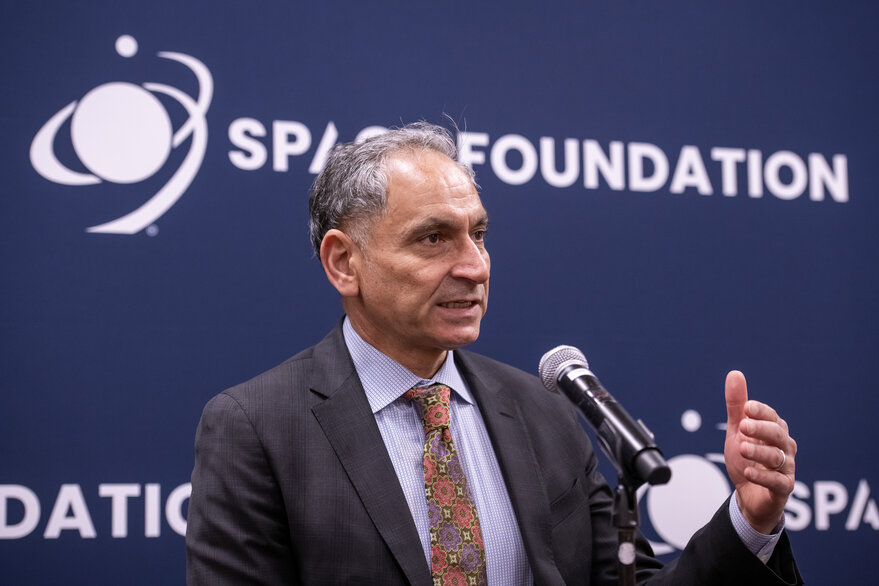
美国太空军太空发展局(SDA)局长古尔帕塔普·“GP”·桑杜在科罗拉多斯普林斯举行的第41届太空研讨会上讨论了在导弹发射前对其进行拦截的挑战。 图片来源:太空基金会
科罗拉多斯普林斯——美国政府机构正与工业界合作,开发在导弹起飞前将其摧毁的工具,这一阶段被称为“发射前阶段”(left of launch)。
雷神情报与空间公司太空情报、监视与侦察副总裁埃里希·埃尔南德斯-巴奎罗在太空研讨会上表示:“随着威胁的演变,我们正在关注威胁的不同方面。为了应对这些威胁、使其面临风险并最终进行防御,必须在作战和任务能力方面发挥不同类型的能力、权限和要素的作用。”
一组专家在4月15日表示,有效的导弹防御需要多样化的技术、政策和战略。
NASA喷气推进实验室国家安全领域执行官丹·张表示:“如果你在时间轴上向左追溯得足够远,你就进入了基础情报领域。当你接近实际发射时间时,你就进入了征候与预警领域。”
丹·张表示,虽然这些类型的分析通常由不同的技术执行并由不同的项目资助,但“它们必须在一个有时非常快、有时可能持续数天的剧本中协同工作。这需要极大的灵活性。”
更快更暗
美国国防和情报机构渴望评估导弹性能。例如,它们的飞行速度有多快?其光谱特征的亮度或暗度如何?
这类信息将帮助太空发展局(SDA)建立“扩散型作战人员太空架构”(PWSA),这是一个用于导弹预警和跟踪的近地轨道卫星星座,因为“我们的工作真正始于导弹发射阶段,”美国太空军太空发展局(SDA)局长古尔帕塔普·“GP”·桑杜表示(
Gurpartap “GP” Sandhoo, U.S, Space Force Space Development Agency (SDA) director discussed the challenge of stopping missiles before they launch at the 41st Space Symposium in Colorado Springs. Credit: Space Foundation
COLORADO SPRINGS – U.S. government agencies are working with industry to develop tools to disrupt missiles before they take flight, a timespan called ‘left of launch.’
“We’re looking at different aspects of the threat as it evolves,” Erich Hernandez-Baquero, Raytheon Intelligence and Space vice president of space intelligence, surveillance, reconnaissance, said at the Space Symposium. “Different types of capabilities, authorities and elements have to come into play, both operationally and in terms of mission capabilities, in order to stay on top of that threat, hold it at risk and ultimately defend against it.”
Effective missile defense will require diverse technologies, policies and strategies, a panel of experts said April 15.
“If you go far enough to the left, you are in the realm of foundational intelligence,” said Dan Chang, NASA Jet Propulsion Laboratory national security area executive. “As you get closer to the actual time of launch, you’re in the realm of indications and warnings.”
While these types of analyses are often carried out with different technologies and funded through distinct programs, “they have to work together in a timeline that sometimes will be very fast and sometimes might play out over a period of days,” Chang said. “It’s something that requires a lot of agility.”
Faster and Dimmer
U.S. defense and intelligence agencies are eager to evaluate missile capabilities. How fast can they travel, for example, and how bright or dim are their spectral signatures?
That type of information will help SDA establish the Proliferated Warfighter Space Architecture, a low‑Earth orbit constellation to warn of and track missiles “because our job really starts at launch,” said Gurpartap “GP” Sandhoo, U.S, Space Force Space Development Agency (SDA) director. “When we look at left of launch, it is understanding, science and knowledge.”
Earth-observation satellites that monitor activity around the world over days, weeks or months may shed light on evolving threats. For instance, Vantor’s Earth-observation constellation provides high-resolution electro-optical imagery.
“But there’s a lot of additional information that comes from combining visible imagery” with synthetic aperture radar, infrared and lidar “to provide context about activity around sites of interest,” said Matt Jenkins, Vantor chief space officer. “We want to track that, understand where it’s going, and provide information on where threats might come from.”
Multiple vendors gather remote sensing data through diverse phenomenologies. While that makes “fielding and engineering and integration harder,” it’s necessary to address “the holistic problem we face,” Sandhoo said. “The threat is going to get faster and dimmer. There is not a single solution.”
Once data on po