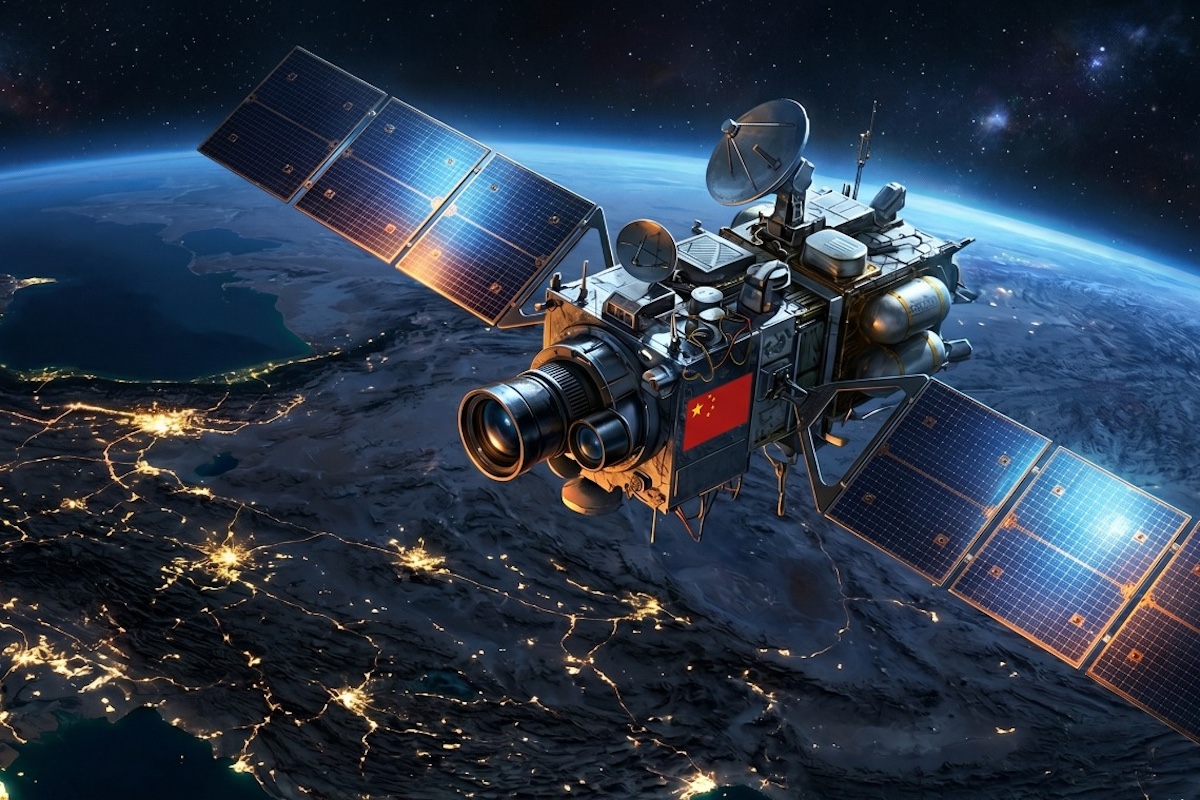
Iran’s reported use of a Chinese-built satellite, combined with alleged Russian intelligence support, signals a shift toward a new model of warfare in which commercially enabled space assets reshape how US forces are tracked and targeted.
Reuters reported that Iran covertly obtained a Chinese-made TEE-01B spy satellite to improve its capacity to observe and potentially target US military bases throughout the Middle East. The report was based on information from the Financial Times (FT), which referenced alleged leaked Iranian military documents.
Linking possible ties between Chinese commercial satellite companies and Iran’s Islamic Revolutionary Guards Corps (IRGC), the US Department of Defense’s (DoD) 2025 China Military Power Report states that “as of August 2024, China-based commercial satellite companies participated in business with the IRGC,” but does not go into detail about the depth of such transactions.
Iranian commanders reportedly tasked the satellite with surveilling key US installations, using time-stamped coordinates, orbital data and imagery captured in March, including before and after drone and missile strikes on those sites.
Targets reportedly included Prince Sultan Air Base in Saudi Arabia, where US President Donald Trump confirmed aircraft were hit on March 14. Other targets were Muwaffaq Salti Air Base in Jordan, regions near the US Fifth Fleet headquarters in Bahrain and Erbil airport in Iraq. Additionally, Iran obtained access to ground stations operated by Beijing-based Emposat, expanding its satellite control capabilities worldwide.
If conclusively proven, the integration of Chinese-enabled satellite imagery and alleged Russian targeting assistance could enhance Iran’s ability to conduct more effective strikes on US and partner forces, highlighting gaps in deterrence, attribution and defense.
Delving into the capabilities of China’s TEE-01B satellite, Earth Eye Co lists it as a Low Earth Orbit (LEO) optical remote-sensing satellite deployed at a 535–545 kilometer altitude, equipped with a panchromatic/multispectral camera delivering 0.52–0.53 meter panchromatic and 2.08–2.12 meter multispectral resolution, with a 14.8 kilometer swath width.
Earth Eye Co mentions that it carries spectral bands including panchromatic, green, red, and near-infrared, supports push-broom, stereo, and along-track imaging, and weighs under 112 kilograms, forming part of a constellation designed for global coverage and a rapid 1.2-hour response.
Similarly, Russia has allegedly provided targeting data to Iran, given their aligned interests against the US and Russia’s substantial space-based ISR infrastructure, though its optical reconnaissance capabilities may be particularly thin, with just a handful of dedicated reconnaissance satellites.
As for how these Russian and Chinese systems complement each other, China’s TEE-01B could provide routine, high-resolution intelligence, surveillance and reconnaissance (ISR) coverage, while state-controlled R
DIRECT2026年4月17日
商业卫星技术重塑战场:中国制造卫星据称助力伊朗
Asia Times亚洲评论媒体,涉华与地区战略分析密集