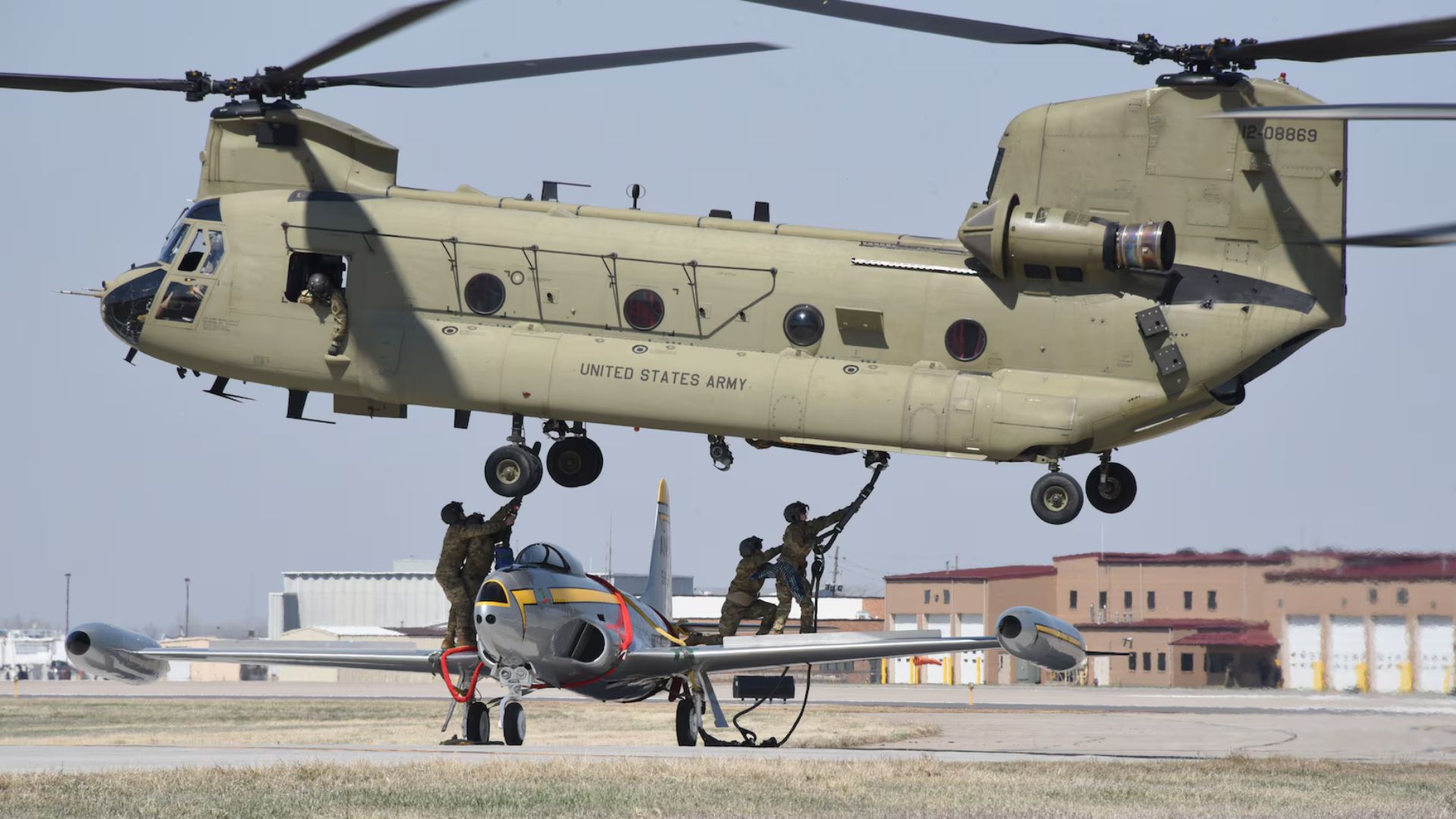
The U.S. Army has taken a significant step toward operational autonomy after a CH-47F Chinook completed its first fully automated approach and landing with no pilot input.
The demonstration used Boeing’s Approach-to-X (A2X) autonomy software, showing the aircraft can deliver precise, repeatable landings under real-world conditions.
The flight marks a practical milestone for supervised autonomy.
The system reduces pilot workload while maintaining control authority in demanding environments.
It also signals a clear path toward integrating automation into frontline operations without replacing human crews.
Precision landing breakthrough
The A2X system builds on an upgraded Digital Automated Flight Control System architecture.
It enables the aircraft to manage approach and landing inputs autonomously. Pilots still define key parameters such as landing zone and descent profile.
Since January 2026, the system has logged more than 150 automated approaches.
It consistently achieved positional accuracy within five feet. Engineers say that the level of precision matters in tight or degraded landing zones.
The system uses real-time navigation data and adaptive control laws.
It continuously adjusts its trajectory during descent. This allows the tandem-rotor platform to operate in complex environments, including night and degraded visual conditions.
Rather than replacing pilots, A2X supports them. Crews can override or adjust inputs mid-flight.
This flexibility ensures responsiveness to threats or sudden mission changes.
The approach reflects a broader Army push toward human-machine teaming.
Development teams designed A2X with direct pilot input. Test crews worked closely with engineers to refine system behavior.
The goal was to match automation with real pilot expectations.
This human-centered approach reduced training complexity. It also improved trust in automated systems during high-stress operations.
For legacy platforms like the Chinook, that alignment remains critical.
The Chinook continues to serve as the backbone of Army heavy-lift operations.
Its twin-rotor design supports missions ranging from air assault to disaster relief.
The aircraft performs reliably in high-altitude and high-temperature environments.
With A2X, the Army aims to enhance survivability and mission consistency. Precision landings reduce exposure time in contested zones.
They also improve efficiency during resupply and special operations missions.
Block II expansion plans
Alongside autonomy upgrades, the Army continues to expand the Chinook fleet.
The service awarded Boeing a $324 million contract for six CH-47F Block II helicopters.
This raises total Block II aircraft under contract to 24.
“Consistent production awards reflect the Army’s confidence in the CH-47F Block II as a critical capability for handling logistics in challenging environments across different domains and in varying operations,” said Heather McBryan, vice president and program manager, Cargo Programs, for Boeing
DIRECT2026年4月17日
美陆军支奴干直升机实现首次无人自主着陆
US Army CH-47F Chinook helicopter makes first autonomous landing without human input
趣味工程工程科技媒体,适合抓军工创新、AI、无人系统与前沿装备