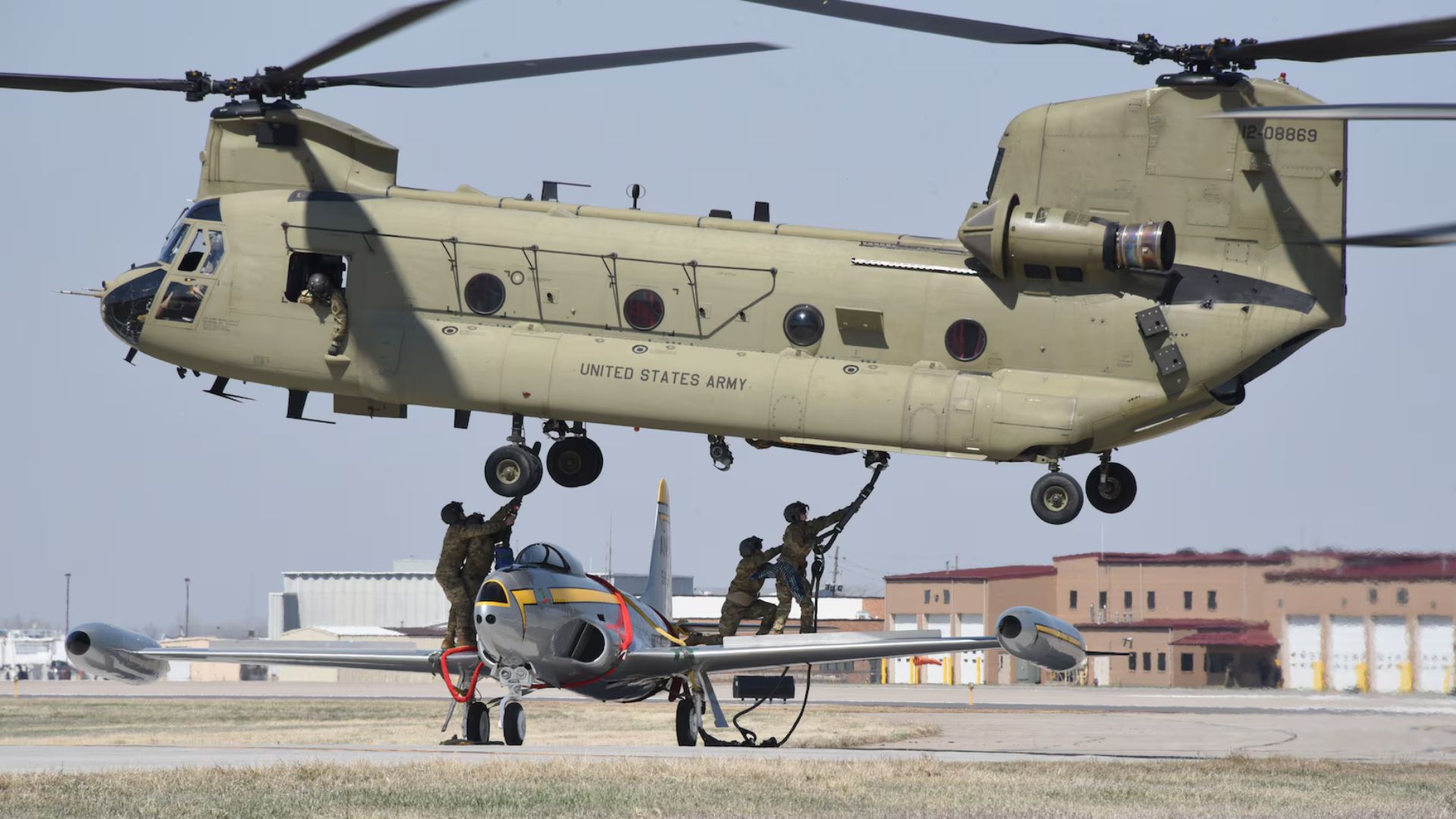
美国陆军在一架CH-47F“支奴干”完成首次全自动进场和着陆(无需飞行员输入)后,在作战自主化方面迈出了重要一步。此次演示使用了波音公司的Approach-to-X (A2X)自主软件,展示了飞机在真实环境下进行精确、可重复着陆的能力。这次飞行标志着受监督自主化的一个实际里程碑。
该系统在减轻飞行员工作量的同时,在苛刻的环境中保持控制权。它还发出了一个明确的信号,即在不取代人类机组人员的情况下,将自动化集成到一线行动中。
精密着陆突破
A2X系统建立在升级的数字自动飞行控制系统架构之上。它使飞机能够自主管理进场和着陆输入。飞行员仍然定义关键参数,如着陆区和下降剖面。自2026年1月以来,该系统已记录了150多次自动进场,始终实现5英尺以内的位置精度。工程师表示,这种精度水平在狭窄或退化的着陆区至关重要。
该系统使用实时导航数据和自适应控制律,在下降过程中不断调整其轨迹。这使得串列双旋翼平台能够在复杂环境中运行,包括夜间和低能见度条件。A2X并非取代飞行员,而是支持他们。机组人员可以在中途覆盖或调整输入。这种灵活性确保了对威胁或突发任务变化的反应能力。
这种方法反映了陆军推动人机协同的更广泛努力。开发团队根据飞行员的直接反馈设计了A2X。测试机组与工程师紧密合作以完善系统行为,目标是使自动化符合飞行员的实际期望。这种以人为中心的方法降低了培训复杂性,并提高了在高压行动中对自动化系统的信任。
The U.S. Army has taken a significant step toward operational autonomy after a CH-47F Chinook completed its first fully automated approach and landing with no pilot input.
The demonstration used Boeing’s Approach-to-X (A2X) autonomy software, showing the aircraft can deliver precise, repeatable landings under real-world conditions.
The flight marks a practical milestone for supervised autonomy.
The system reduces pilot workload while maintaining control authority in demanding environments.
It also signals a clear path toward integrating automation into frontline operations without replacing human crews.
Precision landing breakthrough
The A2X system builds on an upgraded Digital Automated Flight Control System architecture.
It enables the aircraft to manage approach and landing inputs autonomously. Pilots still define key parameters such as landing zone and descent profile.
Since January 2026, the system has logged more than 150 automated approaches.
It consistently achieved positional accuracy within five feet. Engineers say that the level of precision matters in tight or degraded landing zones.
The system uses real-time navigation data and adaptive control laws.
It continuously adjusts its trajectory during descent. This allows the tandem-rotor platform to operate in complex environments, including night and degraded visual conditions.
Rather than replacing pilots, A2X supports them. Crews can override or adjust inputs mid-flight.
This flexibility ensures responsiveness to threats or sudden mission changes.
The approach reflects a broader Army push toward human-machine teaming.
Development teams designed A2X with direct pilot input. Test crews worked closely with engineers to refine system behavior.
The goal was to match automation with real pilot expectations.
This human-centered approach reduced training complexity. It also improved trust in automated systems during high-stress operations.
For legacy platforms like the Chinook, that alignment remains critical.
The Chinook continues to serve as the backbone of Army heavy-lift operations.
Its twin-rotor design supports missions ranging from air assault to disaster relief.
The aircraft performs reliably in high-altitude and high-temperature environments.
With A2X, the Army aims to enhance survivability and mission consistency. Precision landings reduce exposure time in contested zones.
They also improve efficiency during resupply and special operations missions.
Block II expansion plans
Alongside autonomy upgrades, the Army continues to expand the Chinook fleet.
The service awarded Boeing a $324 million contract for six CH-47F Block II helicopters.
This raises total Block II aircraft under contract to 24.
“Consistent production awards reflect the Army’s confidence in the CH-47F Block II as a critical capability for handling logistics in challenging environments across different domains and in varying operations,” said Heather McBryan, vice president and program manager, Cargo Programs, for Boeing