Germany has launched a new research initiative to assess whether lithium trapped in ancient saline brines found nearly 14,000 feet underground can be extracted to help power Europe’s electric vehicles (EVs).
The work, part of the RoLiXX project, focuses on the North German Basin (NGB), the Central European Basin System’s (CEBS) largest basin, which reportedly holds significant potential for lithium extraction.
Data suggests that the location contains approximately 43 million tons of lithium carbonate equivalent dissolved in deep, hot, salty formation waters (brine) within Permian Rotliegend sandstones dating back around 300 million years.
Dominik Soyk, from Neptune Energy, which coordinates the initiative, described lithium as crucial to the energy transition. “With RoLiXX, we are investigating the hitherto little-researched potential of deep waters containing lithium in the Rotliegend of the North German Basin,” he stated.
Deep lithium reserves
The Rotliegend, a rock layer in the North German Basin, is located at a depth of 9,800 to 16,400 feet (three to five kilometers), beyond the German low mountain ranges. It is considered particularly promising for deep waters containing lithium.
To assess its potential, the team involved in the 36-month-long project will now use existing deep boreholes to systematically analyze and scientifically evaluate the resource for the first time. Data suggests lithium levels in some areas are high enough to signal a major untapped resource.
The initiative follows after Neptune Energy confirmed that Germany holds one of the world’s largest lithium resource bases, in September 2025. “This means that one of the world’s largest project-based lithium resources is located in Northern Saxony-Anhalt,” Neptune Energy said at the time.
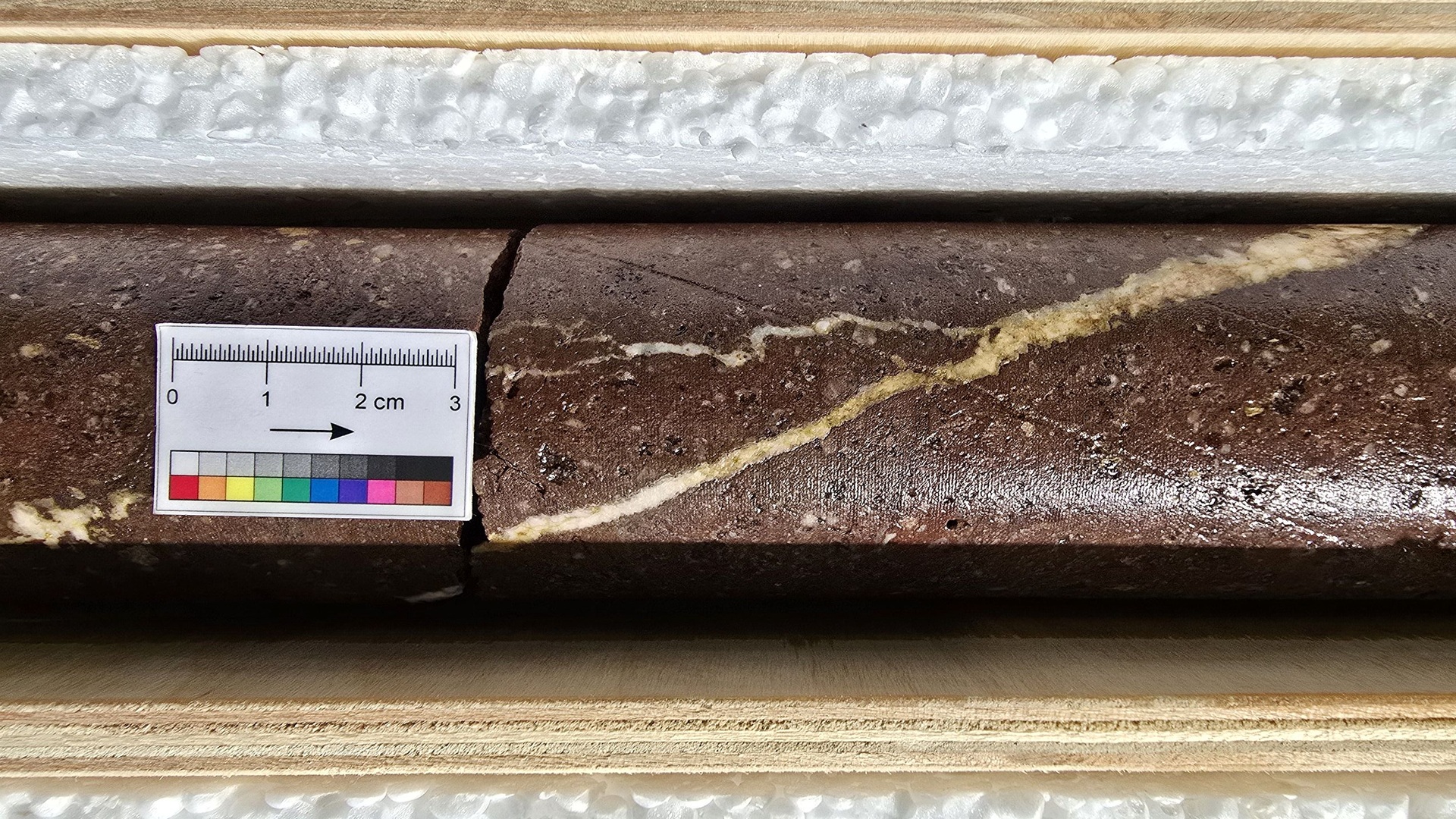
A rock sample from a depth of nearly 13,800 feet (4,200 meters).Credit: Berlin Institute of Technology
But extracting lithium from these brines presents huge technical challenges. While the brines contain a complex mix of dissolved elements, changes in pressure and temperature during extraction can cause minerals to precipitate out of solution.
These scaling deposits (hard, mineral-based buildups) can clog equipment, as well as reduce the efficiency of pumping and processing systems. That is why to tackle the issue, the team is aiming to develop extraction methods specifically designed for high-salinity conditions.
Powering EV batteries
According to the researchers, one of their key goals is to enable lithium recovery while minimizing the formation of solid residues that could disrupt operations or even lead to environmental concerns.
Moreover, the scientists are also conducting detailed geological and geochemical analyses to better understand how lithium is stored and mobilized underground.
By investigating Rotliegend drill cores and the surrounding rock units, they hope to identify lithium-bearing minerals, map their distribution and reconstruct the processes that lead to their formation.
Th
DIRECT2026年4月17日
德国北德盆地发现巨量锂资源有望助力欧洲战略能源独立
300-million-year-old German Basin could hold one of Europe’s largest lithium resources
趣味工程工程科技媒体,适合抓军工创新、AI、无人系统与前沿装备