德国启动了一项新的研究计划,旨在评估被锁定在地下近14,000英尺深处的古代盐水中的锂是否可以被提取,以帮助为欧洲的电动汽车(EV)提供动力。
这项工作是RoLiXX项目的一部分,重点关注北德盆地(NGB),这是中欧盆地系统(CEBS)中最大的盆地,据报道拥有巨大的锂提取潜力。数据表明,该地点包含约4300万吨碳酸锂当量,溶解在约3亿年前二叠纪红层砂岩深处的热盐水中。
海王星能源(Neptune Energy)的Dominik Soyk负责协调该倡议,他称锂对能源转型至关重要。“通过RoLiXX项目,我们正在调查北德盆地红层砂岩中含锂深层水迄今为止研究较少的潜力,”他表示。
深层锂储备
红层砂岩是北德盆地的一个岩层,位于9,800至16,400英尺(3至5公里)的深度,超出了德国低山脉的范围。它被认为对含锂深层水特别具有前景。
为了评估其潜力,参与这个为期36个月项目的团队现在将利用现有的深层钻孔,首次对该资源进行系统分析和科学评价。数据显示,某些地区的锂含量足够高,预示着这可能是一项尚未开发的主要资源。
该倡议是在海王星能源于2025年9月确认德国拥有世界最大的锂资源基地之一后发起的。当时该公司表示:“这意味着世界上基于项目的最大锂资源之一位于萨克森-安哈尔特州北部。”
然而,从这些盐水中提取锂面临着巨大的技术挑战。
Germany has launched a new research initiative to assess whether lithium trapped in ancient saline brines found nearly 14,000 feet underground can be extracted to help power Europe’s electric vehicles (EVs).
The work, part of the RoLiXX project, focuses on the North German Basin (NGB), the Central European Basin System’s (CEBS) largest basin, which reportedly holds significant potential for lithium extraction.
Data suggests that the location contains approximately 43 million tons of lithium carbonate equivalent dissolved in deep, hot, salty formation waters (brine) within Permian Rotliegend sandstones dating back around 300 million years.
Dominik Soyk, from Neptune Energy, which coordinates the initiative, described lithium as crucial to the energy transition. “With RoLiXX, we are investigating the hitherto little-researched potential of deep waters containing lithium in the Rotliegend of the North German Basin,” he stated.
Deep lithium reserves
The Rotliegend, a rock layer in the North German Basin, is located at a depth of 9,800 to 16,400 feet (three to five kilometers), beyond the German low mountain ranges. It is considered particularly promising for deep waters containing lithium.
To assess its potential, the team involved in the 36-month-long project will now use existing deep boreholes to systematically analyze and scientifically evaluate the resource for the first time. Data suggests lithium levels in some areas are high enough to signal a major untapped resource.
The initiative follows after Neptune Energy confirmed that Germany holds one of the world’s largest lithium resource bases, in September 2025. “This means that one of the world’s largest project-based lithium resources is located in Northern Saxony-Anhalt,” Neptune Energy said at the time.
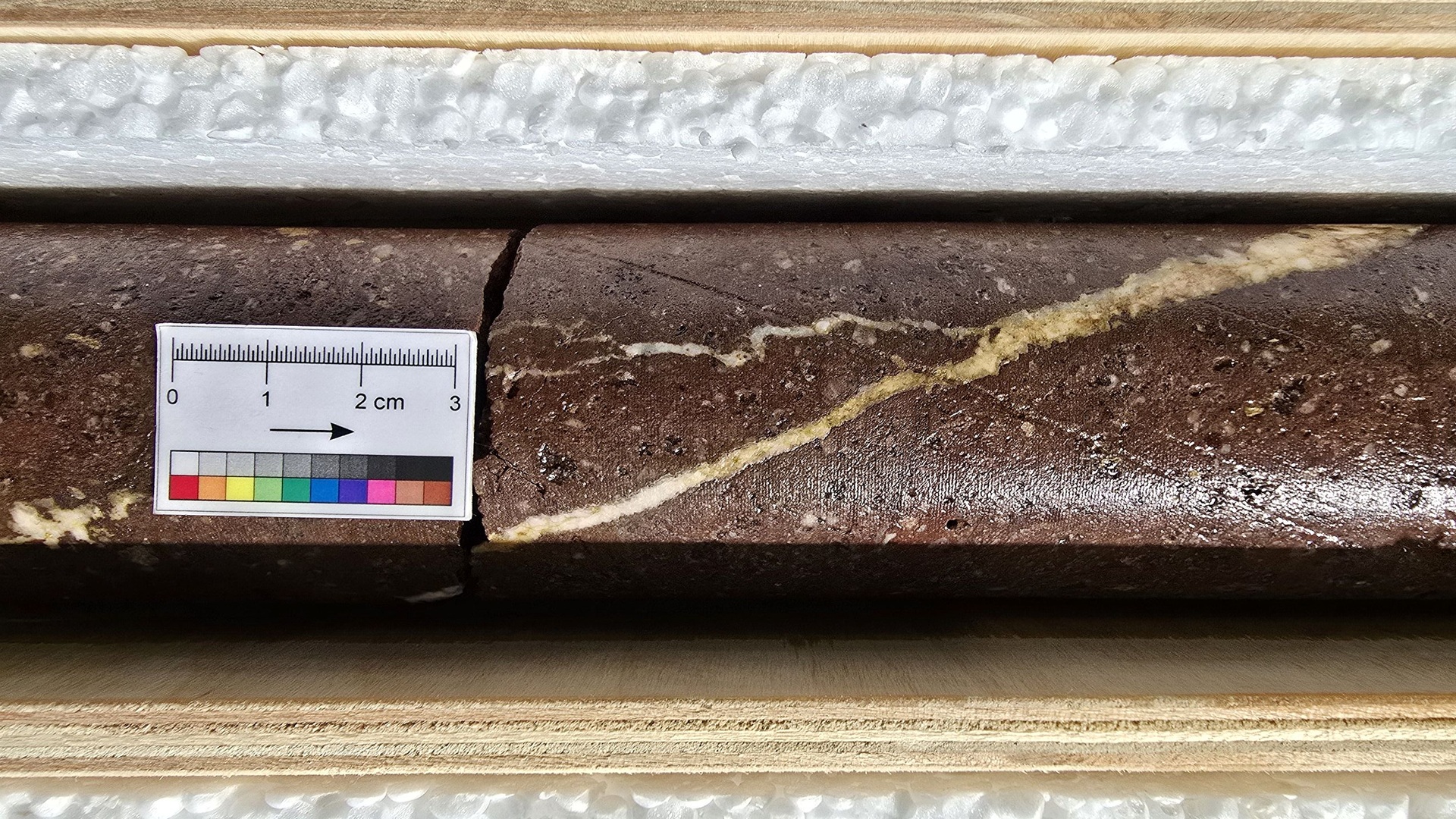
A rock sample from a depth of nearly 13,800 feet (4,200 meters).Credit: Berlin Institute of Technology
But extracting lithium from these brines presents huge technical challenges. While the brines contain a complex mix of dissolved elements, changes in pressure and temperature during extraction can cause minerals to precipitate out of solution.
These scaling deposits (hard, mineral-based buildups) can clog equipment, as well as reduce the efficiency of pumping and processing systems. That is why to tackle the issue, the team is aiming to develop extraction methods specifically designed for high-salinity conditions.
Powering EV batteries
According to the researchers, one of their key goals is to enable lithium recovery while minimizing the formation of solid residues that could disrupt operations or even lead to environmental concerns.
Moreover, the scientists are also conducting detailed geological and geochemical analyses to better understand how lithium is stored and mobilized underground.
By investigating Rotliegend drill cores and the surrounding rock units, they hope to identify lithium-bearing minerals, map their distribution and reconstruct the processes that lead to their formation.
Th