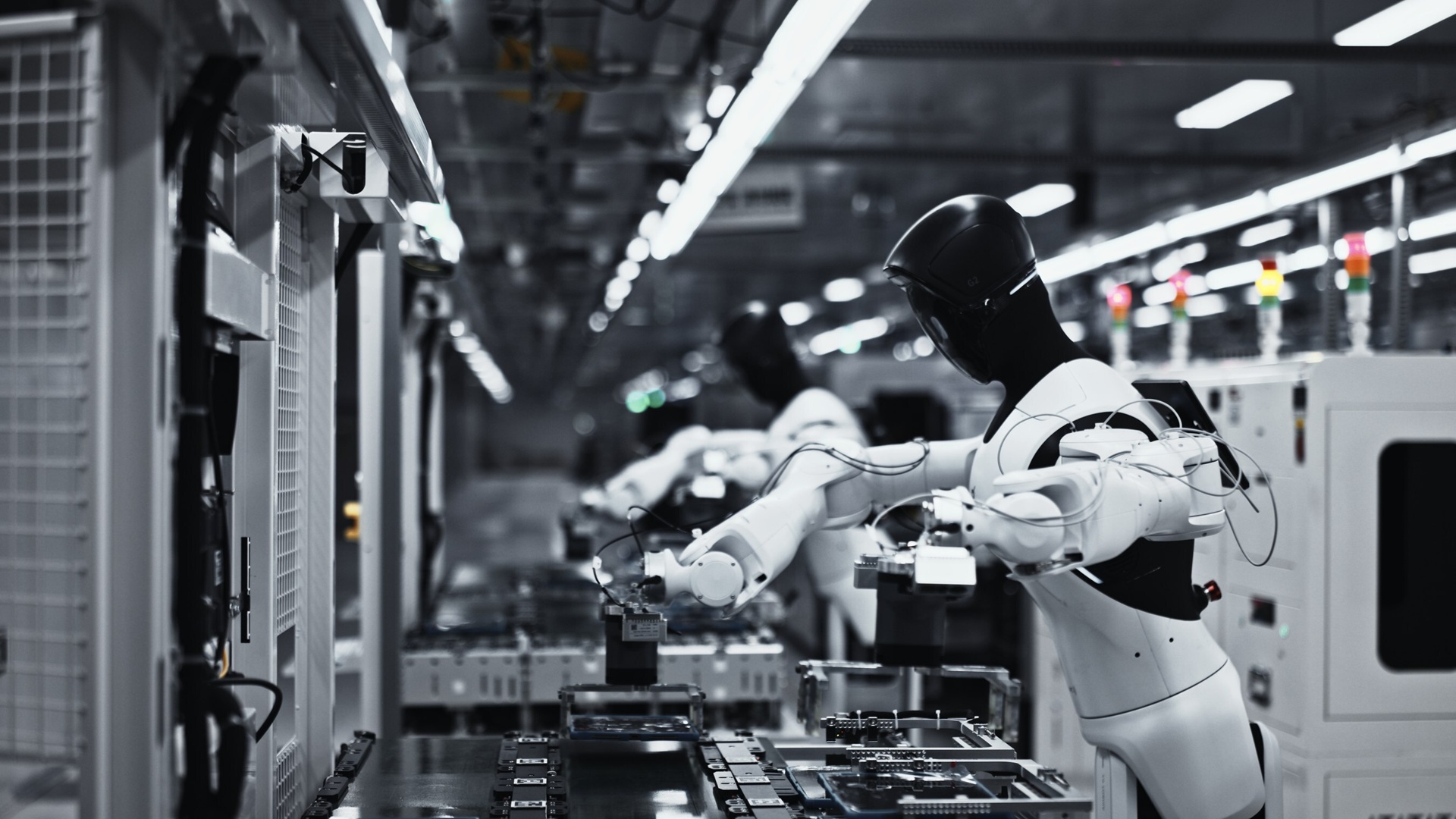
灵驱科技(AGIBOT)已将其G2人型机器人部署到中国真实的消费电子制造生产线中,标志着从受控测试向真实工厂运营的转变。
此次部署是在龙旗科技的平板电脑生产设施中进行的,机器人现已直接集成到正在进行的生产工作流中。该公司表示,这是其具身智能系统首次在消费电子核心制造流程中大规模使用。
这些机器人正在平板电脑组装线上运行,主要在多媒体综合测试(MMIT)工位工作。在这里,它们处理精密任务,如拿起设备、将其放入测试夹具,以及分拣成品或不合格单元。
据灵驱科技介绍,G2系统与人类操作员并肩工作,能够适应混合型号生产,无需定制工具或对生产线进行重大重新设计。该系统设计用于快速换线,允许工厂在不同产品类型之间切换并减少停机时间。
灵驱科技声称,机器人可以在连续生产线上高效运行。报告的性能指标包括:每小时吞吐量高达310台,每项任务的周期约为19至20秒,成功率超过99.9%。该公司还表示,生产线集成在36小时内完成,机器人支持全天候运营,并在不同班次中保持稳定的产出。
公司及其制造合作伙伴将此次部署描述为向电子制造业可扩展的工业具身智能系统迈出的一步。他们认为,该系统减少了对刚性自动化设置的依赖,并提高了处理短产品周期和多样化设备型号的灵活性。
“2026年标志着具身智能大规模部署的开始,”灵驱科技合伙人、高级副总裁兼具身事业部总裁姚茂清博士表示。
AGIBOT has deployed its G2 humanoid robots into a live consumer electronics manufacturing line in China, marking a shift from controlled testing to real factory operations.
The deployment is taking place at Longcheer Technology’s tablet production facility, where the robots are now integrated directly into ongoing production workflows.
The company says this is the first time its embodied AI systems have been used at large scale inside core manufacturing processes for consumer electronics.
The robots are operating on tablet assembly lines, primarily at Multimedia Integrated Testing (MMIT) stations. Here, they handle precision tasks such as picking up devices, placing them into testing fixtures, and sorting finished or defective units.
According to AGIBOT, the G2 systems work alongside human operators and adapt to mixed-model production without requiring custom tooling or major line redesigns. The system is designed for fast changeovers, allowing factories to shift between product types with reduced downtime.
AGIBOT claims the robots can operate with high efficiency on continuous production lines. Reported performance includes throughput of up to 310 units per hour, cycle times of around 19 to 20 seconds per task, and a success rate exceeding 99.9 percent.
The company also states that production line integration was completed within 36 hours, with robots supporting round-the-clock operations and maintaining stable output across shifts.
The company and its manufacturing partner describe the deployment as a step toward scalable industrial embodied AI systems in electronics manufacturing.
They argue that the system reduces dependence on rigid automation setups and improves flexibility in handling short product cycles and varied device models.
“2026 marks the beginning of large-scale deployment for embodied intelligence,” said Dr. Yao Maoqing, Partner, Senior Vice President, President of Embodied Business Unit at AGIBOT.
“This project demonstrates that embodied AI is no longer experimental. It is a practical, production-ready capability that can operate reliably under real industrial conditions and deliver measurable economic value.”
From lab to assembly line
“This deployment represents more than a technical milestone, it marks the first real-world validation of embodied AI in consumer electronics precision manufacturing,” said Li Long, General Manager of Longcheer’s Robotics Division.
“Working closely with AGIBOT, we accelerated the path from innovation to production. In just four months, the AGIBOT G2 was integrated into Longcheer’s mass production line, delivering stable, continuous operation and meeting all key targets. This milestone highlights a scalable path forward for embodied AI in manufacturing.”
The deployment positions AGIBOT’s G2 as part of a broader push toward software-driven industrial robotics that can adjust to real-time production demands.
The company says it plans to scale deployments to 100 robots by Q3 2026 and expand into sector