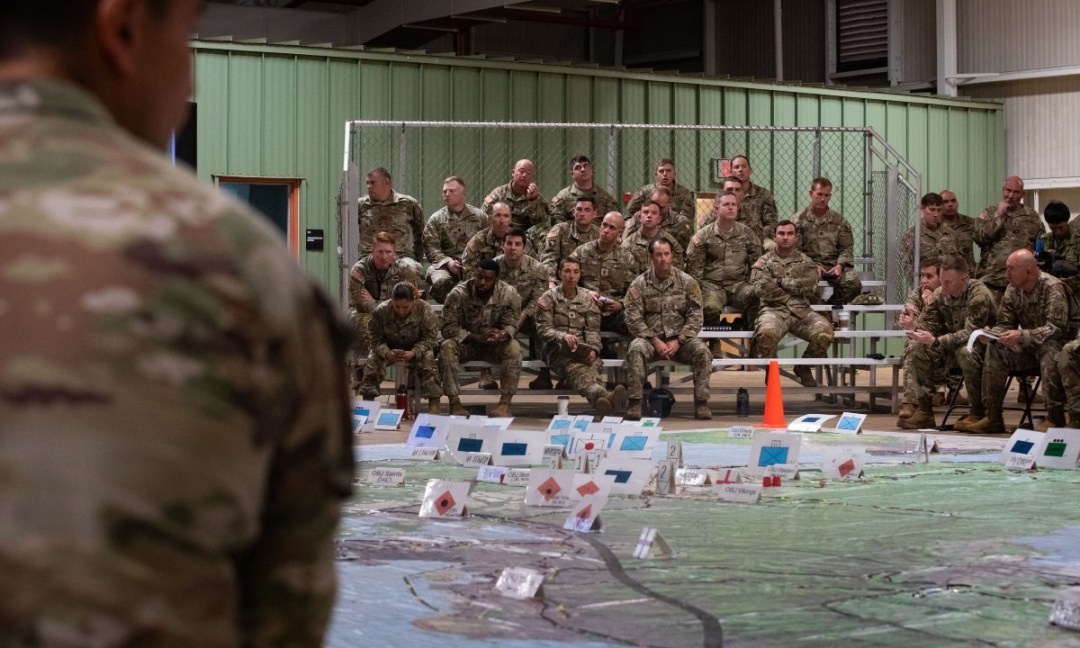
A division major updates a common operational picture during a campaign in the Pacific. An engineer company leaves one mobile brigade combat team and joins another on a different island. A signal package shifts with it. The icon moves in seconds. The operation does not. The gaining brigade now needs lift, fuel, maintenance support, communications integration, protection, reception, staging, onward movement, and rehearsals. The losing brigade now needs replacement capacity or a revised scheme of maneuver. The sustainment architecture changes across distance and water. The task organization decision looked simple. It reshaped the operation.
Major General James Bartholomees and Major Greg Scheffler’s recent Modern War Institute article captures the logic of the Army’s renewed division-centric approach. The Army is rediscovering the division as the warfighting unit of action. Divisions now hold and synchronize more artillery, intelligence, signal, cyber, electronic warfare, engineer, and sustainment capability. Brigade combat teams receive mission-tailored packages built for a specific fight. Division-separate battalions function as warfighting headquarters. Supporting formations stay mobile enough to keep pace with maneuver. Those principles fit the battlefield the Army expects to fight on. They also illuminate friction that senior leaders should address now.
The friction sits in command and control, in leader development, and in the institutional habits of an Army that learned to fight for two decades through large brigade combat teams with more capability living inside the brigade. The transformed division asks commanders and staffs to think in a different way. A task organization decision now drives movement planning, support relationships, sustainment demand, command-post design, communications architecture, and protection priorities. The Army needs leaders who can see those requirements early and staffs who can translate them into action during planning and execution.
The transformed division is a sound operational idea. The Army needs divisions that can integrate capabilities across depth and connect subordinate brigades to the larger campaign. The friction grows from execution. The Army has shifted responsibility upward faster than it has prepared the force to exercise that responsibility. The result appears inside division headquarters, between divisions and brigades, and across the institutions that educate the officers who fill those headquarters.
Where Senior Leaders Should Worry
The first source of friction is the burden on the division staff. The MWI article describes the movement of key capabilities upward from the brigade combat team to division-controlled formations. That change gives division headquarters more authority to build a force package tailored to any specific mission. It also gives the headquarters far more integrating work. A division staff now has to align engineers, signal, intelligence, sustainment, protection, and fir
DIRECT2026年4月17日
美国陆军以师为核心的作战转型需克服的指挥摩擦问题
The Command Friction that the Army’s Division-Centric Warfighting Approach Must Overcome
西点军校现代战争研究平台,适合抓战法战略、条令与台海议题研判